
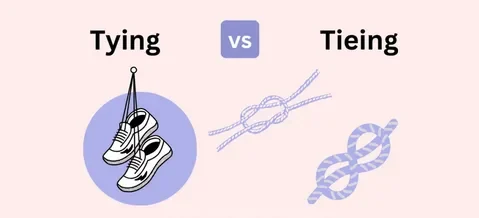
If you have ever paused over Tying or Tieing, you are not alone. The confusion comes from a simple-looking spelling problem: should you add -ing directly to tie, or should the ending change first? For modern American English, tying is the standard form you should normally use. The spelling follows a common pattern in which verbs ending in -ie change those letters to y before adding -ing. For example, lie becomes lying, and die becomes dying. However, there is an important dictionary nuance. Merriam-Webster records tieing as a variant, while Cambridge identifies tying as the present participle of tie.
Quick Answer: Tying or Tieing?
Tying is the standard and preferred spelling in contemporary American English. Use tying in everyday, academic, professional, and formal writing. Cambridge lists tying as the present participle of tie, and the Language Portal of Canada explicitly gives tie → tying as the spelling pattern for verbs ending in -ie.
There is one useful qualification: tieing is recorded as a variant in Merriam-Webster. That does not make it the best default choice for modern writing. If you want the form that readers, dictionaries, and contemporary writing normally expect, choose tying.
What Does “Tying” Mean?
Tying is the present participle of the verb tie. It describes the action of fastening, connecting, securing, or making something hold together. Cambridge gives tying as the present participle and lists tie with meanings related to fastening materials, making knots, and holding things together.
For example, you might say, “She is tying her shoelaces,” or “They are tying the ropes together.” The word can also have a figurative meaning. You can talk about tying ideas together, tying a decision to a condition, or tying a score in a competition. Cambridge specifically lists tie for finishing with the same score and for showing connections between things.
Definition of Tying
The word tying refers to the act of fastening, connecting, binding, or linking something. Its exact meaning depends on the sentence.
Consider these examples:
- She is tying a ribbon around the gift.
- He is tying the boat to the dock.
- The students are tying their ideas together.
- The two teams are tying the score.
In each example, tying describes an action that connects one thing to another or brings things into a particular relationship.
Tying as an Ongoing Action and Gerund
You will commonly see tying in a progressive verb phrase, such as “He is tying his shoes.” Here, tying forms part of the present progressive construction.
It can also function as a gerund when the activity itself becomes the subject or object of a sentence. For example, “Tying knots requires practice.” The spelling stays the same in both uses because the word is still formed from the verb tie.
Why Is “Tying” Spelled With “Y”?
The answer comes from an English spelling rule for verbs ending in -ie. When these verbs take -ing, the -ie changes to y. The Language Portal of Canada gives these examples directly: die → dying, lie → lying, tie → tying, and vie → vying.
So you should not simply attach -ing to tie and leave every letter unchanged. The useful pattern is:
| Base verb | -ing form |
| tie | tying |
| lie | lying |
| die | dying |
| vie | vying |
This pattern gives you a practical memory aid. When a verb ends in -ie, check whether the ie → y change applies before adding -ing.
The -ie to -y Spelling Rule
The basic rule is straightforward:
verb ending in -ie → change -ie to -y + -ing
Therefore:
tie → ty + ing → tying
The change prevents the awkward form that would result from mechanically adding -ing. The Language Portal specifically identifies tie → tying as an example of this spelling rule.
However, do not treat every English spelling rule as an absolute law. English contains many exceptions and historical variations. The same Language Portal advises writers to rely on a good dictionary when a spelling rule does not clearly settle a question.
Why You Do Not Normally Write “Tieing”
Tieing looks logical if you simply take tie and add -ing. That is probably why the spelling causes confusion.
In standard modern usage, however, tying is the form you should choose. Cambridge lists tying as the present participle of tie, while the official spelling guidance gives tie → tying.
There is a nuance worth remembering. Merriam-Webster’s current entry records tieing as a variant. So saying that the spelling has never existed would be too absolute. For normal American writing, though, tying remains the clearer and safer choice.
Similar Examples: Lie, Die, and Tie
The easiest way to remember the pattern is to group related verbs together:
lie → lying
die → dying
tie → tying
Once you remember these three forms, tying becomes much easier to spell. You are not memorizing an isolated word. You are recognizing a broader spelling pattern.
Tying vs Tieing: What Is the Difference?
The practical difference is mainly one of standard usage and recommendation. Tying is the form used by major learner dictionaries for the present participle of tie. Cambridge’s American Dictionary gives tying as the present participle and tied as both the past tense and past participle.
Tieing, meanwhile, deserves a more careful description than “not a word.” Merriam-Webster records it as a variant of tying. Therefore, the most accurate advice is to use tying as your normal form, especially when writing for a contemporary American audience.
Tying — The Preferred Modern Form
Use tying when you describe the action of fastening, connecting, linking, or making an equal score.
For example:
She is tying her shoes before the race.
You can also use it in figurative expressions:
The writer is tying the evidence to the main argument.
Because dictionaries such as Cambridge identify tying as the present participle, it is the form you should expect in standard grammar references and ordinary writing.
Tieing — A Recorded Variant
The spelling tieing can appear in dictionary and historical usage discussions. Merriam-Webster currently lists it as a variant under tie. That makes the issue more nuanced than simply calling the form impossible.
Still, if you are writing an essay, business email, report, website, or other contemporary content, tying is the better choice. It follows the familiar spelling pattern and matches the present-participle form listed by Cambridge.
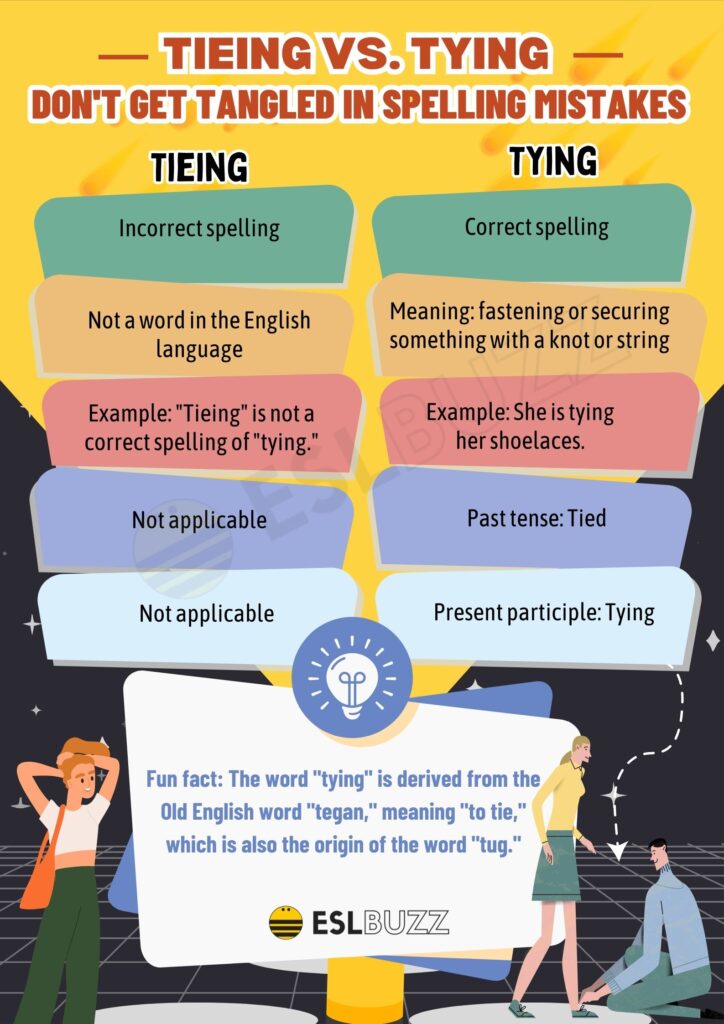
Tying, Tied, and Tie: A Quick Comparison
| Form | Grammatical role | Example |
| tie | Base verb | I need to tie my shoes. |
| tied | Past tense/past participle | She tied the ribbon. |
| tying | Present participle/gerund | She is tying the ribbon. |
This distinction matters because writers sometimes confuse tying with tied. If the action is happening now or functions as a gerund, tying is usually the form you need. Cambridge confirms the basic verb forms as tie, tied, and tying.
When Should You Use “Tying”?
Use tying whenever you need the present participle or gerund form of tie. In practice, that covers much more than physical knots. You can use the word for shoes, ropes, packages, scores, relationships between ideas, and other connections.
For example, “She is tying her shoes” describes an action happening now. “Tying the cables neatly makes the workspace safer” uses the word as a gerund. “The teams are tying the score” uses another established meaning of tie. Cambridge lists both the fastening sense and the equal-score sense.
Use Tying for an Ongoing Action
Use tying with forms of be when describing an action in progress.
Examples include:
- He is tying his shoelaces.
- She is tying a ribbon.
- They are tying the ropes together.
- The sailor is tying the boat to the dock.
These sentences describe actions taking place at the time of speaking or within a particular ongoing situation.
Use Tying as a Gerund
A gerund is an -ing form that functions like a noun.
For example:
Tying knots takes practice.
Here, tying names an activity rather than simply describing what someone is doing. You could also write:
I enjoy tying decorative bows.
The spelling remains tying because the underlying verb is still tie.
Use Tying for Equal Scores
The word also appears in sports and competitions.
For example:
The home team is tying the game.
You can also say:
The runners are tying for first place.
Cambridge defines tie in this sense as finishing with the same number of points or at the same level in a competition.
Use Tying in Common Expressions
You will encounter tying in several familiar expressions.
Examples include tying the knot, tying a bow, tying things together, and tying up loose ends. You can also use the word figuratively when discussing connections, such as tying an idea to evidence or tying a result to a particular cause.
Common Mistakes With Tying and Tieing
The most common error is straightforward: writers add -ing directly to tie and produce tieing. That approach feels logical because many English verbs accept -ing without a visible spelling change. However, verbs ending in -ie follow a different pattern in this case.
Another mistake is assuming that every dictionary variation has the same status in everyday writing. The existence of a recorded variant does not mean you should use both forms interchangeably. When you want the conventional contemporary form, tying is the sensible choice.
Adding -ing Directly to “Tie”
A common spelling mistake looks like this:
Incorrect for standard contemporary usage: She is tieing her shoes.
Preferred: She is tying her shoes.
The problem comes from treating tie like a regular verb whose letters remain unchanged before -ing. Instead, apply the ie → y pattern.
Confusing Tying With Trying
Do not confuse tying with trying.
Tying means fastening, connecting, or linking something.
He is tying the rope.
Trying means attempting to do something.
He is trying to open the door.
The two words look similar, but their meanings and base verbs are completely different.
Confusing Tying With Tied
Another frequent problem involves tense.
She is tying the package.
She tied the package yesterday.
The first sentence describes an ongoing action. The second describes a completed action. Cambridge lists tied as both the past tense and past participle of tie.
Using Tieing in Formal Writing
If you are writing an essay, professional document, business email, or published article, tying is the better default.
This advice does not require pretending that tieing has never appeared. Merriam-Webster records the variant. The practical point is that tying is the form major contemporary learner dictionaries present as the present participle.
Tying Examples in Everyday English
The word tying appears in both literal and figurative contexts. You might use it when talking about shoelaces, ribbons, ropes, or packages. You can also use it when discussing scores or connections between ideas.
The examples below show how the word works naturally in American English.
Tying Shoes, Hair, and Clothing
- Maria is tying her shoelaces.
- He is tying his tie before the meeting.
- She is tying her hair back.
- The child is tying an apron around his waist.
Cambridge’s American Dictionary includes examples involving shoelaces, ribbons, and fastening materials.
Tying Knots, Ropes, and Packages
- The sailor is tying the boat to the dock.
- We are tying the ropes together.
- She is tying a knot in the string.
- He is tying the package with a ribbon.
These examples use the basic fastening sense of tie. Cambridge defines the verb as fastening or holding things together with string, rope, or similar material.
Tying Scores in Sports
- The team is tying the game.
- The players are tying the score at two points each.
- The runners are tying for first place.
This use is not metaphorical guesswork. It comes directly from the established competition-related meaning of tie.
Tying Ideas and Concepts Together
The word can also describe a connection between ideas.
For example:
The researcher is tying the results to the original hypothesis.
You can also write:
The final paragraph does a good job of tying the main ideas together.
Cambridge recognizes related constructions such as tie something in with something and tie something to something for showing connections between things.
Correct and Incorrect Sentence Examples
| Incorrect or nonpreferred | Preferred |
| She is tieing her shoes. | She is tying her shoes. |
| They are tieing the ropes. | They are tying the ropes. |
| He is tieing the package. | He is tying the package. |
| The team is tieing the score. | The team is tying the score. |
The practical lesson is simple: when you need the modern standard -ing form of tie, write tying.
How to Remember “Tying” Easily
The easiest memory trick is to connect tying with lying and dying. All three begin with verbs ending in -ie, and all three change -ie to -y before -ing. The official Language Portal spelling guidance specifically groups tie → tying, lie → lying, and die → dying together.
You can remember the pattern as a small chain:
tie → tying
lie → lying
die → dying
If you remember those three examples, you will have a useful pattern rather than a single isolated spelling fact.
Use the “IE → Y” Memory Trick
When you see a verb ending in -ie, stop before adding -ing. Check whether the spelling changes to y.
For tie:
tie → ty + ing → tying
That quick mental step can prevent the common mistake of writing tieing.
Remember “Lie → Lying” and “Die → Dying”
Think of these words as a three-word memory group:
tie, lie, die
Their -ing forms are:
tying, lying, dying
This makes the spelling easier to recall when you are writing quickly.
Use a Quick Decision Test
Ask yourself:
“Am I using the -ing form of the verb tie?”
If the answer is yes, choose tying.
If you are describing a completed action, you probably need tied instead:
She is tying the bow now.
She tied the bow yesterday.
Tying or Tieing: Practice Quiz
Try these questions before checking the answers. The goal is to practice the spelling rule in realistic sentences.
Choose the Correct Spelling
- She is ___ her shoes.
tying / tieing - They are ___ the ropes together.
tying / tieing - The team is ___ the score.
tying / tieing - He spent ten minutes ___ the package.
tying / tieing - ___ knots can be difficult at first.
Tying / Tieing
Quiz Answers
- Tying — tie changes to ty before -ing.
- Tying — the standard present-participle form is tying.
- Tying — the same spelling applies when discussing an equal score.
- Tying — the -ing form remains tying.
- Tying — here, tying functions as a gerund.
Remember that dictionaries can record variants. Merriam-Webster records tieing as a variant, but tying is the form you should normally choose in contemporary writing.
Final Verdict: Tying or Tieing?
When you need the standard -ing form of tie, choose tying. It is the form identified by Cambridge as the present participle, and official spelling guidance gives tie → tying as the expected pattern for verbs ending in -ie.
The word tieing deserves a little nuance because Merriam-Webster records it as a variant. Therefore, it is more accurate to call tying the standard and preferred modern form rather than claiming that tieing is absolutely nonexistent.
For everyday American English, academic writing, professional communication, and published content, the safest choice is clear:
Write “tying,” not “tieing.”
FAQs
Is tying the correct spelling?
Yes. Tying is the standard present-participle spelling used by major contemporary dictionaries such as Cambridge.
Is tieing a word?
It can be found as a recorded variant. Merriam-Webster lists tieing as a variant, although tying is the preferred practical choice for modern writing.
Why does tie become tying instead of tieing?
English spelling guidance changes -ie to -y before -ing in verbs such as tie, lie, and die.
What is the present participle of tie?
The present participle is tying. The basic forms are tie, tied, and tying.
Is tying a verb or a noun?
It can function as a verb form or a gerund. In “She is tying a knot,” it forms part of a verb phrase. In “Tying knots takes practice,” it functions as a gerund.
Can I use tying in formal writing?
Yes. Tying is appropriate in academic, professional, formal, and everyday writing.
Is tying the same as trying?
No. Tying means fastening or connecting something, while trying means attempting to do something.
How can I remember the spelling of tying?
Remember the pattern tie → tying, alongside lie → lying and die → dying. The -ie → -y change makes the correct form easier to recall.
Conclusion
The spelling question has a simple practical answer: use “tying.” It is the standard present-participle form of tie and follows the -ie → -y spelling pattern before -ing. You can see the same pattern in lie → lying and die → dying.
The one detail worth remembering is that tieing is recorded as a variant by Merriam-Webster. That makes an absolute “never a word” claim misleading. For modern American writing, however, tying is the clear choice. Whether you are tying shoes, tying a knot, tying a score, or tying ideas together, that spelling will serve you well.