If you have ever hesitated over Useage vs. Usage, you are not alone. The two spellings look almost identical, and the extra “e” can seem reasonable because the base word is use. However, standard American English recognizes usage as the correct spelling. Useage is a common spelling mistake, not a different word with its own meaning. The word usage also does more than describe grammar. It can refer to how language is used, how something is treated or handled, or how much something is used. Understanding these meanings makes the spelling easier to remember and helps you choose between use and usage accurately.
Useage vs. Usage: The Quick Answer
Usage is the correct standard spelling in modern American English. Useage is a misspelling that should be corrected to usage in ordinary writing.
| Word | Correct? | Part of Speech | Basic Meaning |
| Usage | Yes | Noun | The way, manner, amount, or practice of using something |
| Useage | No | — | A common misspelling of usage |
If you are writing an essay, email, report, website, or professional document, choose usage. Major dictionaries define usage as an established English noun, including meanings related to language and the way or amount something is used.
The important point is that you should not treat useage as an alternative spelling. When you see the extra “e,” check the word again. In standard writing, the established form is usage.
What Does “Usage” Mean?
Usage is a noun with several closely related meanings. In language, it describes the way people use words or a language. For example, a dictionary can discuss current English usage, while a teacher might explain proper word usage in an essay. Cambridge also uses usage for the way something is treated or used.
The word also describes the amount, degree, or pattern of use. You might discuss water usage, electricity usage, phone usage, or internet usage. In business settings, usage can describe how customers use a product or service and the amount of a resource they consume.
Usage in Language and Grammar
When you see language usage, the phrase concerns how speakers and writers actually use language. English usage can therefore include common ways of using words, expressions, and grammatical forms. Grammar and usage overlap, but they are not identical. Grammar focuses more on language structure, while usage often concerns established or observed ways of using language.
Usage as the Way Something Is Used
Usage can describe the manner in which someone uses an object, service, or system. For example, a manual might discuss proper equipment usage, while a software company might analyze customer usage patterns. In these contexts, the word focuses on the way something is used rather than the simple act of using it.
Usage as an Amount or Degree of Use
You will often see usage when something can be measured. Data usage, water usage, and energy usage can all refer to the amount consumed or used during a particular period. Cambridge’s American Dictionary specifically gives credit card usage as an example of this sense.
Why Is “Useage” Incorrect?
The confusion usually comes from the appearance of the base word use. Because use ends with an “e,” a writer may assume that the letter should remain before an ending such as -age. That makes useage look plausible at first glance. However, English spelling does not always work by simply attaching an ending to a modern base word.
The safest approach is to memorize the established spelling: usage. A useful memory aid is “use → usage,” but you should not mistake that shortcut for a complete historical explanation of the word. Etymological sources trace usage through Anglo-French and Old French usage to Latin usus. The word has been used in English for centuries, with recorded senses involving custom, use, language, and the manner of using something.
Why People Spell It “Useage”
The extra “e” feels natural because use is such a familiar English word. Writers may mentally combine use with -age and produce useage. Search results also show that this explanation appears frequently on spelling websites. However, the established dictionary form is usage, so the extra letter does not belong in standard modern English.
Is “Useage” a Word?
For normal American English writing, treat useage as a misspelling rather than an accepted alternative spelling. If you encounter it in an email, article, assignment, or online post, the intended word is almost certainly usage.
It is better to say that useage is not the standard spelling than to make sweeping historical claims about every occurrence of the letter sequence. The important practical rule remains simple: use usage in your own standard English writing.
Useage vs. Usage: What’s the Difference?
The difference is primarily one of standard spelling and grammatical status. Usage is an established noun with several dictionary meanings. Useage is not the standard alternative form you should select when writing modern American English.
| Feature | Usage | Useage |
| Standard spelling | Yes | No |
| Standard English noun | Yes | No |
| Established dictionary meaning | Yes | No |
| Used for language | Yes | No |
| Used for amount or degree of use | Yes | No |
| Appropriate in professional writing | Yes | No |
The pronunciation of usage in U.S. English is listed by Cambridge as /ˈjuː.sɪdʒ/. The spelling does not change between American and British English, although pronunciation details can vary by speaker and dialect.
Spelling Difference
The correct spelling contains one “e”:
usage
The incorrect form contains an unnecessary additional “e”:
useage
If you are proofreading your work, searching for useage can quickly help you catch this particular spelling error.
Meaning and Part of Speech
Usage functions as a noun. It can describe language practice, the way something is used, an amount of use, or an established practice.
Useage, by contrast, does not provide a separate standard meaning that you need to learn. In ordinary writing, replace it with usage.
How to Use “Usage” Correctly in a Sentence
Use usage when you need a noun describing the way something is used, an amount of use, or an established language practice. The context determines the exact meaning.
For example, language-related usage might appear in a sentence such as, “The style guide explains modern English usage.” Technology provides another common context: “The app tracks monthly data usage.” Resource-related sentences can use the word as well, such as, “The city is monitoring household water usage.” These examples reflect dictionary meanings that extend beyond grammar alone.
Usage in Grammar and Language
- Correct word usage improves clarity.
- The dictionary discusses current English usage.
- Regional language usage can change over time.
- The teacher explained proper usage of the expression.
Here, usage concerns how words or language forms are used. It does not mean that usage itself is a grammar rule.
Usage for Technology
- The app monitors mobile data usage.
- Our internet usage increased last month.
- The company studies customer usage patterns.
- Software usage can help businesses understand user behavior.
Cambridge’s Business English Dictionary specifically includes usage patterns, internet usage, and usage charges among common business contexts.
Usage for Resources
- The household reduced its water usage.
- Electricity usage was higher during the summer.
- The report measures annual energy usage.
- The company tracks resource usage across its offices.
In these examples, usage often relates to measurable consumption or the amount of a resource used.
Usage in Business and Professional Writing
Professional documents commonly use usage when discussing customers, products, services, technology, or resources. For example, a company might report customer usage patterns or compare monthly service usage.
However, do not replace the simple verb use with usage. “I use the software every day” is natural. “I usage the software every day” is incorrect because usage is a noun.
Common Phrases and Expressions With “Usage”
Usage appears in many established phrases. These are better understood as common collocations than as idioms because their meanings are generally predictable from the individual words.
Common Usage
Common usage refers to a word, expression, practice, or form that people commonly use. In language discussions, you may see phrases such as “common English usage” or “accepted usage.”
Language Usage
Language usage describes how people use language. It can involve vocabulary, expressions, grammar, style, and regional conventions.
Usage Patterns
Usage patterns describe recurring ways or levels of use. Businesses might study customer usage patterns to understand when and how people use a service.
Water Usage
Water usage refers to how much water is used or the way water is used. It frequently appears in discussions about households, agriculture, utilities, and conservation.
Data and Internet Usage
Data usage commonly describes the amount of digital data consumed. Internet usage can describe the amount or extent of internet use.
Usage Charges and Usage Caps
A usage charge is a fee based on how much a customer uses a service. A usage cap sets a limit on how much of a service or resource can be used under particular terms. These expressions are common in technical and business contexts.
Prohibited Usage
Prohibited usage describes a use that rules, policies, contracts, or regulations do not allow. The exact meaning depends on the document or service involved.
Usage vs. Use: Understanding the Difference
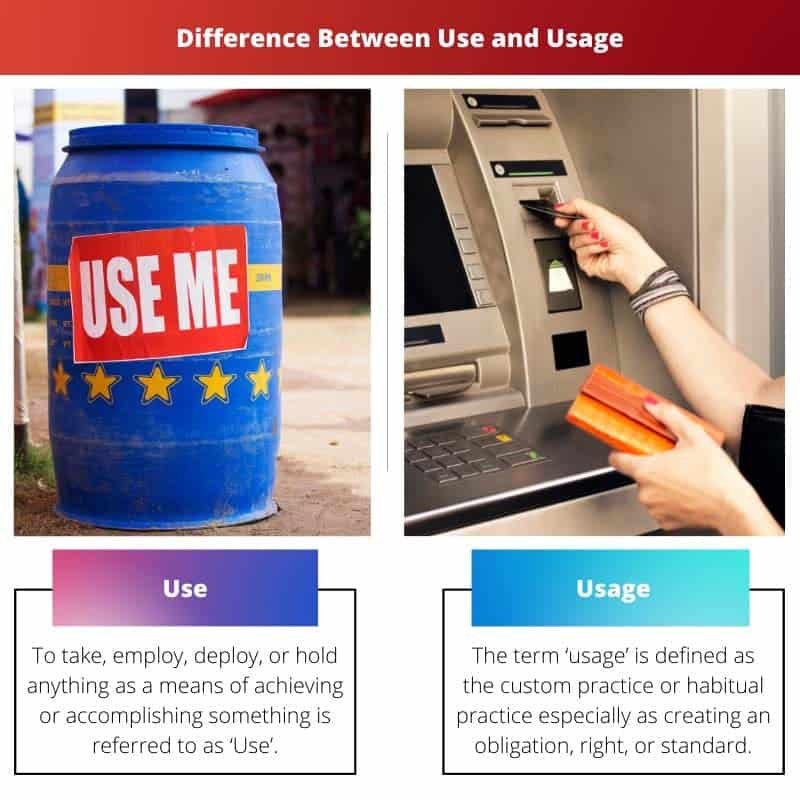
One of the most useful distinctions is between use and usage. They are related words, but they do different grammatical jobs. Use can function as both a verb and a noun, while usage functions as a noun.
For example, you might say, “I use this application every day.” Here, use describes an action. You could then say, “My application usage has increased.” Here, usage describes a broader amount or pattern of use. Choosing between them depends on what you want the sentence to express.
“Use” as a Verb
Use use as a verb when you describe an action:
I use my laptop for work.
We use less electricity in the summer.
She uses the app every morning.
The word directly identifies what someone does.
“Use” as a Noun
Use can also be a noun:
This tool has several uses.
The room has no practical use right now.
Here, use refers to a purpose, function, or instance of using something.
“Usage” as a Noun
Usage is useful when you want to discuss a broader pattern, manner, amount, or established practice:
Our monthly electricity usage increased.
The report analyzes customer usage.
The dictionary explains modern English usage.
A simple test can help. If you are describing what someone does, use may be the natural choice. If you are discussing how, how much, or in what pattern something is used, usage may fit better.
Common Mistakes With “Usage” and “Useage”
The most obvious mistake is adding an unnecessary “e.” However, writers can also misuse usage by treating it as a verb or by using it where the simpler word use would be more natural.
Mistake 1: Writing “Useage”
Incorrect:
The website tracks customer useage.
Correct:
The website tracks customer usage.
The same correction applies to phrases such as internet usage, water usage, and proper English usage.
Mistake 2: Using “Usage” as a Verb
Incorrect:
I usage my phone every day.
Correct:
I use my phone every day.
Usage is a noun. It cannot simply replace the verb use.
Mistake 3: Confusing “Use” and “Usage”
Incorrect:
I usage this software at work.
Correct:
I use this software at work.
However:
My software usage has increased.
The first sentence describes an action. The second describes a pattern or amount of use.
Mistake 4: Assuming Similar Spelling Means Similar Formation
English spelling can be less predictable than it first appears. The fact that use ends in “e” does not mean you should preserve that letter in every related word.
The established form is usage. A spelling memory aid can help, but it is better to learn the complete word than to apply a supposed universal “drop the e” formula.
Proofreading Tip
If you frequently make this error, use your word processor’s spell-check feature and search your finished document for useage. Then check each result manually. Most instances will simply need to become usage.
Synonyms and Related Words for “Usage”
The best synonym depends on the meaning you intend. Use, application, and utilization can overlap with usage, but they do not work in every context.
When usage means the way something is used, use, application, or employment may fit. When it refers to customary practice, words such as practice, custom, or convention can be appropriate. When it refers to the amount of something consumed, consumption may be a better choice.
For example, water usage can often be discussed as water consumption. However, English usage does not normally mean English consumption. Context determines which related word communicates the intended idea most accurately.
Synonyms for “Usage” Meaning Use
Depending on context, related terms include:
- use
- application
- employment
- utilization
- operation
Synonyms for “Usage” Meaning Practice
For language or social conventions, related words can include:
- practice
- custom
- convention
- habit
- tradition
Synonyms for “Usage” Meaning Consumption
When discussing measurable resources, alternatives may include:
- consumption
- utilization
- expenditure
Do not treat these words as perfect substitutes. A synonym that works for resource consumption may sound unnatural in a discussion of English language usage.
How to Remember the Correct Spelling of “Usage”
The easiest approach is to memorize the established spelling as one complete word:
usage
You can also use the simple memory aid use → usage. Just remember that this is a practical spelling trick, not a full explanation of the word’s historical origin. Etymological evidence traces usage through Old French to Latin rather than supporting a simplistic modern “use + age” derivation.
The Extra “E” Test
When you see useage, pause and remove the extra “e”:
useage → usage
Then reread the sentence. If you mean the way, amount, manner, or practice of using something, usage is the established form.
Practice the Word in Context
Memorizing phrases can make the spelling easier:
- English usage
- common usage
- word usage
- data usage
- internet usage
- water usage
- energy usage
- usage patterns
Seeing the word repeatedly in meaningful contexts is more useful than memorizing an isolated spelling rule.
Usage or Useage: Examples and Practice
The quickest way to reinforce the distinction is to compare correct and incorrect sentences.
Correct Usage Examples
Language:
Correct English usage can make professional writing clearer.
Technology:
The application tracks monthly data usage.
Resources:
The household reduced its water usage.
Business:
The company analyzed customer usage patterns.
Education:
The teacher explained proper word usage.
Everyday life:
Excessive phone usage can become distracting.
Incorrect “Useage” Examples
The following sentences contain the common spelling mistake:
❌ The website monitors customer useage.
✓ The website monitors customer usage.
❌ Her English useage needs improvement.
✓ Her English usage needs improvement.
❌ Check your monthly data useage.
✓ Check your monthly data usage.
The correction is straightforward. Replace the nonstandard spelling with usage.
Use or Usage? Practice
Choose use or usage:
- I ___ this program every morning.
- Our monthly electricity ___ increased.
- Proper word ___ improves clarity.
- We ___ less water during winter.
- The report tracks customer ___ patterns.
Answers
- use
- usage
- usage
- use
- usage
The pattern becomes clearer when you focus on grammar. Use can describe an action, while usage commonly describes a broader pattern, manner, amount, or established practice.
Frequently Asked Questions About Useage vs. Usage
Is “useage” a correct word?
No. Usage is the standard spelling you should use in modern American English. Useage is generally a misspelling.
How do you spell “usage”?
Spell it usage: U-S-A-G-E. Do not add an extra “e” after the “s.”
Why do people spell “usage” as “useage”?
The extra “e” probably looks natural because the related word use already ends in “e.” English spelling does not always follow a simple add-a-suffix pattern.
What does “usage” mean in simple terms?
Usage can mean the way something is used, how much it is used, or an accepted way of using language or something else.
What is the difference between “use” and “usage”?
Use can be a verb or noun. Usage is a noun commonly referring to a manner, pattern, amount, or customary practice of use.
Is “usage” only related to grammar?
No. You can discuss data usage, water usage, energy usage, phone usage, software usage, and many other forms of use.
Can “usage” be used in formal writing?
Yes. Usage is a standard English noun and is appropriate in academic, professional, technical, and everyday writing.
How do you pronounce “usage” in American English?
Cambridge lists the U.S. pronunciation as /ˈjuː.sɪdʒ/.
What are some synonyms for “usage”?
Depending on context, possible related words include use, application, utilization, practice, custom, and consumption. The best choice depends on the intended meaning.
Is “usage” a noun or a verb?
Usage is a noun. For the verb, use use: “I use this software every day.”
Final Verdict: Usage or Useage?
When choosing between Useage vs. Usage, choose usage. It is the established standard English noun used for language practices, ways of using things, amounts of use, and broader patterns of use.
The spelling useage may look logical because use ends in “e,” but that extra letter does not belong in the standard form. Remember usage, and use use when you need the related verb.
The simplest takeaway is this: usage is correct; useage is a spelling mistake in ordinary modern English.