
Have you ever wondered whether to write too many or to many? The two phrases sound alike, but they do not serve the same purpose in a sentence. The correct choice depends on what you want to say. In American English, too many usually describes an excessive number of people or things. However, to many can also be grammatically correct when to functions as a preposition, as in “The announcement was important to many people.” Understanding this difference helps you avoid a common writing mistake in emails, school assignments, articles, and everyday messages.
Too Many vs To Many: Quick Answer
Use too many when you mean more people or things than are needed, wanted, or appropriate, as in “There are too many cars on the road.” Use to many when to has its own grammatical role, as in “The announcement was important to many people.” The phrases are not interchangeable because too expresses excess, while to can indicate a relationship, direction, or recipient.
Key Takeaways
- Too many means an excessive number of countable people or things.
- To many can be correct when to functions as a preposition.
- Write “too many emails” when you mean there are more emails than necessary.
- Write “The message was sent to many employees” when identifying the recipients.
- Too can also mean “also,” while to often indicates direction or introduces a verb.
- Read the complete sentence before deciding which spelling to use.
What Does Too Many Mean?
Too many means more than the appropriate, desired, or necessary number of countable people or things. The word too acts as an adverb that expresses excess, while many refers to a number of countable items.
For example, “I received too many emails today” means the number of emails was excessive for the situation. The phrase does not always mean the quantity is objectively large. What counts as too many depends on the circumstances and the speaker’s judgment.
Examples of Too Many in a Sentence
- There are too many people waiting outside.
- I made too many mistakes on the first draft.
- She bought too many apples for the recipe.
- We have too many meetings scheduled this week.
- The website displays too many advertisements.
- He invited too many guests for the available space.
In each sentence, too many expresses an excessive number.
When Can You Use Too Many Without a Noun?
You can use too many on its own when the noun is already clear from the conversation.
For example:
“We ordered six pizzas, but that was too many.”
The word pizzas does not need to appear again because readers can infer the missing noun from the previous clause.
What Does To Many Mean?
To many is not a fixed phrase meaning “an excessive number.” Instead, it is a combination of the preposition to and the quantity word many. It can be correct when the sentence structure requires to.
The word to can express a relationship, identify a recipient, or indicate who experiences something. The meaning comes from the complete sentence rather than from the two words as a unit.
Examples of To Many in a Sentence
- The announcement was important to many people.
- The company sent invitations to many customers.
- The new policy seemed unfair to many employees.
- This historical event is familiar to many students.
- The charity distributed food to many families.
- Her advice was helpful to many beginners.
These sentences are grammatically correct. They do not mean that the number of people was excessive. Instead, to connects the sentence’s meaning to the people mentioned.
Why Is To Many Sometimes Correct?
Consider the sentence, “The announcement was surprising to many people.”
Here, surprising describes the announcement, and to many people identifies those who found it surprising. Replacing to with too would change the grammatical relationship and make the sentence incorrect in its intended meaning.
The important point is that “to many” is not automatically a spelling error. It is incorrect only when the sentence requires too many to express excess.
What Is the Difference Between Too Many and To Many?
The main difference is grammatical function. Too many expresses an excessive quantity, while to many connects an action, description, or relationship to a large number of people or things.
| Feature | Too many | To many |
|---|---|---|
| Meaning | More than necessary or appropriate | A relationship involving many people or things |
| Role of the first word | Too is an adverb expressing excess | To is usually a preposition |
| Typical use | Describing an excessive count | Identifying recipients or people affected |
| Example | There are too many cars. | The news was surprising to many people. |
| Can the phrase be correct? | Yes, when excess is intended | Yes, when the sentence requires the preposition to |
A Simple Memory Trick
Ask yourself: Am I talking about excess, or am I connecting something to someone?
If you mean an excessive number, use too many. If you are identifying who receives, experiences, or relates to something, check whether to many fits the sentence.
For example:
- “There are too many complaints.” The number is excessive.
- “The decision was disappointing to many customers.” The customers experienced disappointment.
This test is often more reliable than choosing the spelling based on sound alone.
How Are Too, To, and Two Different?
Too, to, and two are commonly confused because they sound alike in ordinary speech. However, they have different meanings and grammatical functions.
Too: Excess or Also
Use too when you mean “more than needed” or “also.”
- The coffee is too hot to drink.
- There are too many boxes in the hallway.
- I want to come too.
In the first two examples, too expresses excess. In the third, it means “also.”
To: Direction, Relationship, or Verb Marker
Use to to indicate direction, a recipient, a relationship, or the infinitive form of a verb.
- We drove to the airport.
- Send the form to the manager.
- I want to learn English.
- The result was surprising to many people.
The word’s grammatical function depends on the sentence.
Two: The Number 2
Use two when you mean the number after one and before three.
- I bought two notebooks.
- The class has two new students.
- We need two more chairs.
Can All Three Appear in One Sentence?
Yes. Consider this example:
“I sent two invitations to the office, and that was too many for one event.”
Each word has a different role: two gives a number, to indicates direction, and too many expresses excess.
How to Choose the Correct Phrase Step by Step
Follow these steps when proofreading a sentence containing too many or to many.
- Identify the intended meaning. Decide whether you mean an excessive number or a relationship involving many people or things.
- Check the word after the first one. If many introduces a countable quantity that is excessive, too many is probably correct.
- Look at the rest of the sentence. Phrases such as “important to many people” and “sent to many customers” need the preposition to.
- Try a substitution. If “more than necessary” fits the meaning, choose too. If the sentence expresses direction, a recipient, or a relationship, to may be required.
- Read the sentence aloud and proofread it. Sound alone cannot distinguish these words, so confirm that the spelling matches the meaning.
A Quick Editing Checklist
- Does the sentence describe an excessive number?
- Does to connect an action or description to a recipient or group?
- Have I checked the entire sentence rather than the phrase alone?
- Does the chosen word preserve the intended meaning?
- Have I checked other easily confused words, such as too, to, and two?
Common Mistakes With Too Many and To Many
Most errors happen when writers use to where they mean excess. However, treating every occurrence of to many as incorrect creates another problem.
Mistake 1: Using To Many to Express Excess
Incorrect: There are to many people in the room.
Correct: There are too many people in the room.
The writer means that the number of people is excessive, so too many is required.
Mistake 2: Replacing To Many With Too Many After a Description
Incorrect: The announcement was surprising too many people.
Correct: The announcement was surprising to many people.
Here, to connects the description surprising with the people who experienced that reaction. The phrase does not describe an excessive number.
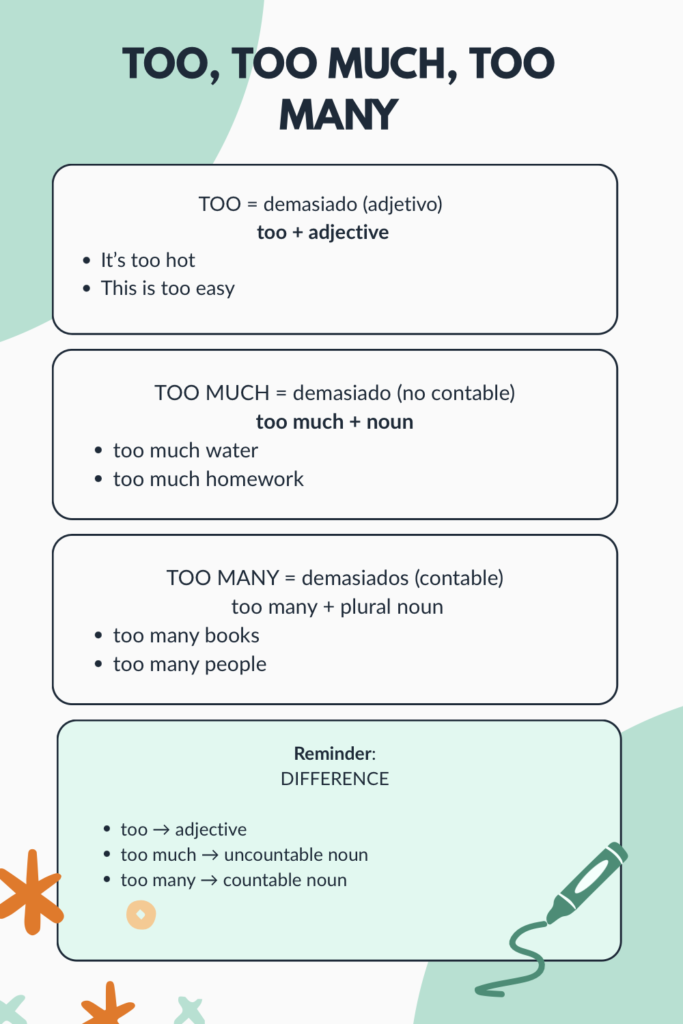
Mistake 3: Confusing Too Many With Too Much
Use too many with countable plural nouns and too much with uncountable nouns.
- Correct: There are too many chairs.
- Correct: There is too much water.
- Incorrect for standard usage: There are too much chairs.
- Incorrect for standard usage: There is too many water.
The distinction is useful because too remains the same, while many and much depend on the type of noun.
Mistake 4: Assuming The Phrases Sound Different
In ordinary speech, to and too generally sound alike. A listener may not notice the difference, but a reader will see the spelling. Always use the intended meaning and sentence structure to decide which word belongs in the text.
Too Many vs Too Much vs So Many
These expressions are related, but they do not mean exactly the same thing.
| Expression | Meaning | Example |
|---|---|---|
| Too many | An excessive number of countable items | There are too many emails. |
| Too much | An excessive amount of something uncountable | There is too much noise. |
| So many | A large number, often emphasizing quantity or emotion | There are so many emails to read. |
So many does not automatically mean “more than appropriate.” It can simply emphasize a large quantity. For example, “There were so many stars in the sky” describes a large number without necessarily suggesting a problem.
By contrast, “There were too many cars in the parking lot” suggests that the number exceeded what was suitable or manageable.
Why Does This Difference Matter in Writing?
Choosing between too many and to many helps readers understand your meaning without confusion. The distinction matters in academic assignments, workplace messages, website content, and everyday communication.
For example, a sentence in a business email that says “We sent invitations to many clients” means many clients received invitations. Writing “We sent too many invitations” means the number of invitations was excessive. One small spelling change can alter the message.
Clear word choice also makes proofreading easier. Purdue University’s Online Writing Lab includes to and too among common words that sound alike but have different meanings. Cambridge Dictionary’s English Grammar Today explains that too many is used for quantities that exceed what is needed, wanted, or suitable.
Tools and Resources for Checking Your Grammar
You can usually solve this question by checking the sentence’s meaning, but trusted resources are helpful when you are unsure.
- Cambridge Dictionary: Check how too is used to express excess and how it combines with many.
- Purdue University Online Writing Lab: Review the guide to commonly confused words, including to, too, and two.
- Merriam-Webster Dictionary: Check definitions and usage examples for to and too.
- A grammar checker: Use it to flag possible errors, then review the sentence yourself.
- A final read-through: Search your document for “to many” and check each occurrence in context. Some will be correct, while others may need to change to “too many.”
Automated tools can miss errors that depend on meaning. A quick manual review remains useful, especially in professional writing.
Frequently Asked Questions
1. Is it too many or to many?
Use too many when you mean more people or things than are needed, wanted, or appropriate. For example, “There are too many cars on the road.” To many can also be correct when to serves as a preposition, as in “The announcement was important to many people.” The intended meaning determines the correct form.
2. Is to many ever grammatically correct?
Yes. To many is grammatically correct when to connects an action, description, or relationship to many people or things. For example, “The new rules seemed confusing to many students.” Here, to identifies the people who found the rules confusing. It does not express an excessive quantity.
3. What does too many mean?
Too many means more than the number considered necessary, suitable, wanted, or manageable. It is used with countable people and things, such as books, meetings, cars, or mistakes. For example, “I scheduled too many meetings” suggests that the number of meetings exceeded what was appropriate for the situation.
4. What is the difference between too and to?
Too commonly means “more than needed” or “also,” as in “too many people” or “I want to come too.” To can indicate direction, a recipient, a relationship, or the infinitive form of a verb, as in “go to school” and “to learn.” Their meanings and grammatical roles are different, even though they sound alike.
5. Should I write too many people or to many people?
Both can be correct in different sentences. Write “too many people” when you mean that the number is excessive. Write “important to many people” when you mean that something matters to a large group. The surrounding words determine whether too expresses excess or to connects the sentence to a group.
6. Is it too much or to much?
Use too much when you mean an excessive amount of something, usually with an uncountable noun: “There is too much sugar in the tea.” Use to when the sentence requires the preposition or infinitive marker. “To much” is not the standard spelling for expressing excess.
7. What is the difference between too many and so many?
Too many suggests that a number exceeds what is appropriate or wanted. So many emphasizes a large number but does not necessarily suggest a problem. “There are too many tasks for one afternoon” implies an excessive workload, while “There are so many interesting books” simply emphasizes quantity.
8. How can I remember when to use too or to?
Remember that too has an extra o, which can remind you of “one too many.” If you mean an excessive number, write too many. If you are indicating direction, a recipient, or a relationship, to may be correct. Check the sentence’s meaning because pronunciation alone will not help you choose.

Conclusion: Too Many vs To Many
The difference between too many and to many comes down to meaning and grammar. Use “too many” to describe an excessive number of countable things. Use “to many” when the preposition “to” connects an action, description, or relationship to a group.
Before publishing or submitting your writing, read the complete sentence and ask whether you mean excess or a connection to people or things. This simple check will help you avoid common mistakes in emails, essays, articles, and everyday messages.
Next step: Search your draft for “to many.” Change it to “too many” wherever you mean an excessive number, but keep it when the sentence correctly requires the preposition to.
Author: Editorial Team
Author bio: The editorial team creates practical English-language guides to grammar, spelling, punctuation, and commonly confused words.
Reviewer: [Add the name and relevant qualifications of the human reviewer before publication.]
Editorial note: This guide explains standard American English usage. The intended meaning and complete sentence determine whether too many or to many is correct.