
Should you write annual report, yearly report, or a report published every year? All three expressions relate to a yearly cycle, but they serve different grammatical roles. Choosing the right one can make your writing clearer, more natural, and easier to understand. The difference matters when you write workplace emails, school assignments, business documents, or everyday messages. In most cases, annual works as an adjective, yearly can function as an adjective or adverb, and every year is a phrase that expresses frequency. Their meanings overlap, so the best choice often depends on sentence structure and context. Once you understand these differences, you can choose the right expression without memorizing complicated grammar rules.
Annual vs Yearly vs Every Year: The Direct Answer
Annual, yearly, and every year can all describe something that happens once each year or relates to a one-year period. Annual usually describes a noun, yearly can describe a noun or modify an action, and every year tells readers how often something happens. Choose the expression that fits your sentence and intended meaning.
Key Takeaways
- Annual is primarily an adjective used in phrases such as annual meeting and annual report.
- Yearly can function as an adjective or an adverb.
- Every year is an adverbial phrase that expresses how often something happens.
- All three can communicate a yearly frequency, but their grammatical roles differ.
- Annual often sounds more formal, while every year sounds direct and conversational.
- Check the surrounding sentence before replacing one expression with another.
What Do Annual, Yearly, and Every Year Mean?
These three expressions relate to a recurring yearly schedule or a period of one year. Their main differences involve grammar, sentence structure, and common usage.
What Does Annual Mean?
Annual is primarily an adjective meaning happening once every year or relating to a period of one year. It commonly appears before nouns in professional, academic, and everyday writing.
Examples include:
- Annual report
- Annual meeting
- Annual salary
- Annual review
- Annual conference
- Annual subscription
Example: The company publishes its annual report in March.
Here, annual describes the noun report. It tells readers that the report is produced on a yearly schedule.
The Cambridge Dictionary also uses annual to describe income, salary, profit, and events. See its definition of annual for additional examples.
What Does Yearly Mean?
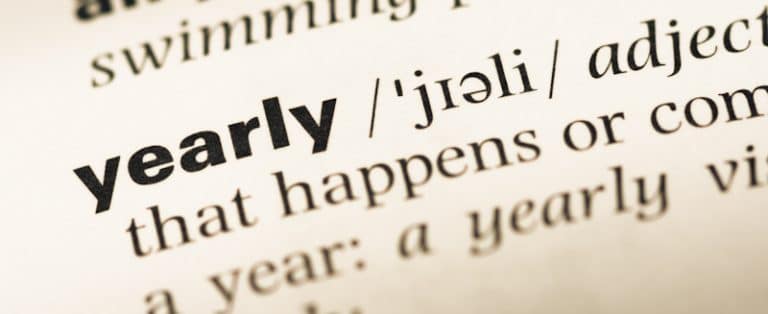
Yearly means happening every year or once every year. Unlike annual, it can function as both an adjective and an adverb.
As an adjective:
“The museum hosts a yearly exhibition.”
Here, yearly describes the noun exhibition.
As an adverb:
“The organization reviews its goals yearly.”
In this sentence, yearly modifies the verb reviews by explaining how often the organization reviews its goals.
The Cambridge Dictionary recognizes both grammatical roles and lists annual and annually among related expressions.
What Does Every Year Mean?
Every year is a phrase that expresses frequency. It generally means each year or once in each year.
Examples:
- We visit our grandparents every year.
- The school holds a science fair every year.
- Our family takes a vacation every year.
In these sentences, every year explains when or how often an action happens.
The expression is particularly useful in everyday conversation because it communicates the schedule directly.
What Is the Difference Between Annual, Yearly, and Every Year?
The most useful distinction is grammatical. Annual normally describes a noun, yearly can describe a noun or modify a verb, and every year functions as a time expression.
| Feature | Annual | Yearly | Every year |
| Main meaning | Happening once a year or relating to a year | Happening once a year | Each year |
| Grammatical role | Primarily adjective | Adjective or adverb | Adverbial phrase |
| Before a noun | Yes | Yes | Not normally |
| After a verb | Not normally by itself | Yes | Yes |
| Typical tone | Often formal or professional | Neutral and flexible | Direct and conversational |
| Example | Annual meeting | Yearly meeting | Meet every year |
| Common business phrase | Annual report | Yearly report | Report published every year |
These expressions overlap in meaning, but their grammatical functions determine where they fit naturally.
Are Annual and Yearly Interchangeable?
Often, yes. You can say annual meeting or yearly meeting without changing the basic meaning.
However, one expression may be more conventional in a particular context.
For example:
- The company released its annual report.
- The company released its yearly report.
Both are understandable and grammatically correct. However, annual report is a well-established phrase in business writing.
The same principle applies to other expressions. Annual review may sound more conventional in a workplace than yearly review, even though both can be correct.
Can You Replace Every Year With Annual?
Not directly in every sentence. The expression every year can describe an action, while annual normally modifies a noun.
Incorrect: We visit the museum annual.
Correct: We visit the museum every year.
Also correct: We visit the museum yearly.
Or: We visit the museum annually.
The problem is grammatical rather than semantic. In the first sentence, the verb visit needs an appropriate adverb or time expression.
When Should You Use Annual?
Choose annual when describing a noun, particularly in professional, academic, administrative, or official writing. It is common in established expressions that describe recurring events, documents, and financial amounts.
Annual in Business Writing
Business documents frequently use annual to identify recurring reports, meetings, reviews, and financial figures.
Examples:
“The board approved the annual budget.”
“The company will hold its annual meeting next month.”
“Employees must complete an annual performance review.”
In each example, annual describes a noun and signals a yearly schedule or period.
Annual in Everyday English
The word is not limited to formal documents. It also works naturally in ordinary conversation.
Examples:
- Our annual family reunion takes place in July.
- The town hosts an annual summer festival.
- We attend the annual school concert.
The best choice depends on the sentence, not simply on whether you are speaking formally or casually.
Does Annual Always Mean Once Every Calendar Year?
Not necessarily. Annual can describe something that occurs once each year or something measured over a one-year period.
A calendar year runs from January through December. However, a business, school, or organization may use a different twelve-month reporting period.
For example, a company’s annual financial report may cover its fiscal year rather than the calendar year.
Practical tip: When discussing a payment, contract, or reporting period, check the actual dates and definitions. The word annual alone does not establish the exact start and end dates.
When Should You Use Yearly?
Use yearly when you need a flexible expression that can describe a noun or modify an action. It works in general writing, workplace communication, and everyday conversation.
Yearly as an Adjective
When yearly appears before a noun, it describes something that happens or is measured once a year.
Examples:
- We receive a yearly allowance.
- The school publishes a yearly calendar.
- The company conducts a yearly review.
In each sentence, yearly modifies the noun that follows it.
Yearly as an Adverb
When yearly modifies a verb, it explains how often an action occurs.
Examples:
- The equipment is inspected yearly.
- Membership fees are reviewed yearly.
- The organization publishes its results yearly.
These sentences are grammatically correct.
However, every year or annually may sound more natural in some situations. Choose the expression that makes the sentence clearest.
When Should You Use Every Year?
Use every year when you want to state directly how often an action happens. It is particularly natural in conversation, general writing, and explanations of routines or traditions.
Everyday Examples
“We visit our cousins every year.”
“The children look forward to the festival every year.”
“I renew my library membership every year.”
These examples place the time expression after the main action.
Examples in Professional Writing
The phrase also works well in business communication when clarity matters more than brevity.
For example:
“The department reviews the policy every year.”
This sentence is direct and easy to understand.
A more formal alternative is:
“The department reviews the policy annually.”
Both sentences communicate a yearly review. The first uses a phrase, while the second uses an adverb.
Why Every Year Often Sounds Natural
The phrase clearly connects an action with its frequency. Readers do not need to interpret an adjective or infer how the word modifies the sentence.
Compare:
“The organization conducts an annual review.”
“The organization reviews its policies every year.”
Both are clear, but they structure the information differently. The first emphasizes the review as an event. The second emphasizes how often the organization performs the action.
What Is the Difference Between Annual and Annually?
Annual is primarily an adjective, while annually is an adverb. Both relate to a yearly schedule, but they fit different grammatical positions.
Compare these examples:
| Annual | Annually |
| Annual meeting | Meet annually |
| Annual report | Publish annually |
| Annual review | Review annually |
| Annual inspection | Inspect annually |
| Annual payment | Pay annually |
Example: The company conducts an annual review.
Here, annual describes the noun review.
Example: The company reviews its policies annually.
Here, annually modifies the verb reviews.
The Cambridge Dictionary defines annually as once every year and provides examples involving reviews, awards, and recurring activities. See its definition of annually.
Do not write “The company reviews its policies annual.” In that sentence, annually or every year is the appropriate choice.
How Do You Choose the Right Expression?
You can select the best expression by following a simple three-step process.
Step 1: Identify What You Want to Describe
First, determine whether you are describing a thing or explaining how often an action occurs.
If you are describing a meeting, report, payment, or event, an adjective may fit naturally.
If you are describing an action, an adverb or time expression may be better.
Step 2: Check the Sentence Structure
Use the following framework:
- Noun: Annual meeting or yearly meeting.
- Action: Meet yearly or meet every year.
- Formal frequency statement: Meet annually.
- Direct everyday statement: Meet every year.
This framework helps you choose a grammatical form before considering tone.
Step 3: Match the Tone to the Audience
For formal documents, annual and annually often work well.
For everyday explanations, every year may sound more natural.
For a flexible alternative, yearly can work as an adjective or adverb.
These are general usage tendencies, not strict rules. The most important consideration is whether the sentence is grammatical, accurate, and clear.
What Common Mistakes Should You Avoid?
The most common errors involve using an adjective where an adverb is needed, placing every year directly before a noun, or assuming that all three expressions fit every sentence.
Mistake 1: Using Annual as an Adverb
Incorrect: The committee meets annual.
Correct: The committee meets annually.
Also correct: The committee meets every year.
Use annual to describe a noun, not as a standalone adverb modifying meets.
Mistake 2: Placing Every Year Directly Before a Noun
Incorrect: The organization held an every year meeting.
Correct: The organization held an annual meeting.
Also correct: The organization held a yearly meeting.
Or: The organization held a meeting every year.
The phrase every year normally works as a time expression, not as a direct adjective before meeting.
Mistake 3: Assuming Annual Always Sounds Better
Annual is common in professional writing, but that does not make it the best option in every sentence.
For example:
Awkward: I visit my friends annual.
Natural: I visit my friends every year.
Also correct: I visit my friends yearly.
The goal is not to use the most formal word. The goal is to use the expression that fits the grammar and context.
Mistake 4: Confusing Yearly With Once a Year in Every Context
Yearly and every year usually communicate a yearly frequency. However, a specific contract, billing policy, or schedule may define a period more precisely.
For example, a subscription described as annual might renew according to the date of purchase rather than on January 1.
If timing affects money, deadlines, or obligations, check the applicable terms instead of relying on a general language rule.
What Tools Can Help You Check Usage?
Dictionaries and grammar references can help you verify definitions and sentence structure. A spellchecker may catch typing mistakes, but it will not always tell you which expression best fits your meaning.
Consult a Trusted Dictionary
The Cambridge Dictionary provides definitions and examples for annual, yearly, and annually.
Use these entries to confirm the grammatical role of each word and review how it appears in context.
Use a Grammar Checker Carefully
Writing tools can flag possible grammatical problems and suggest alternative phrasing.
However, automated suggestions may overlook differences in emphasis or tone. Read the revised sentence yourself before accepting a recommendation.
Follow This Practical Checklist
Before submitting or publishing your writing, ask:
Am I describing a noun or explaining how often an action happens?
Have I used annual before a noun?
If I need an adverb, would yearly or annually fit?
Would every year make the sentence clearer?
Does the expression match the actual schedule or time period?
Have I checked the sentence for grammar, clarity, and unnecessary formality?
This checklist works for school assignments, workplace emails, articles, and everyday messages.
Frequently Asked Questions
1. What Is the Difference Between Annual, Yearly, and Every Year?
All three expressions relate to a yearly cycle. Annual is primarily an adjective, yearly can be an adjective or an adverb, and every year is an adverbial phrase. For example, you can write “annual meeting,” “yearly meeting,” or “a meeting every year,” depending on the sentence structure.
2. Are Annual and Yearly Interchangeable?
Often, yes. Both can describe something that happens once each year, as in annual meeting and yearly meeting. However, established phrases may favor one option. Annual report is especially common in business writing. The expressions share a basic meaning, but grammar, context, and conventional usage influence which one sounds most natural.
3. Is Annual More Formal Than Yearly?
Annual often sounds more formal or conventional in business and official writing. Yearly is flexible and works in both formal and informal contexts. This distinction is a general tendency rather than a strict grammatical rule. Choose the word that fits the sentence and audience instead of assuming one is always better.
4. Is Every Year Grammatically Correct?
Yes. Every year is a standard time expression that explains how often something happens. For example, “We visit the museum every year” is correct. You can also write “We visit the museum yearly” or “We visit the museum annually.” The choice depends on the sentence structure and the tone you want.
5. What Is the Difference Between Annual and Annually?
Annual is primarily an adjective used before nouns, as in “annual review.” Annually is an adverb used to describe an action, as in “The company reviews its policies annually.” Both relate to a yearly schedule, but they cannot be substituted freely because they serve different grammatical functions.
6. Can Yearly Be Used as an Adverb?
Yes. Yearly can function as an adverb meaning every year or once every year. For example, “The equipment is inspected yearly” is grammatically correct. It can also function as an adjective, as in “yearly inspection.” This flexibility distinguishes yearly from annual, which is primarily an adjective.
7. Is Every Year the Same as Once a Year?
In ordinary usage, the expressions often communicate the same frequency. However, context can affect how a schedule is interpreted. For example, an annual subscription may renew every twelve months from the purchase date. If exact timing matters, check the relevant schedule or agreement rather than assuming that every yearly period follows the calendar year.
8. Should I Write Annual Salary or Yearly Salary?
Both annual salary and yearly salary are understandable and grammatically correct. Annual salary is especially common in professional and employment contexts. You can also say “salary per year” when explaining the amount directly. If you are discussing a job offer, confirm whether the figure represents base pay, total compensation, or another defined amount.
Conclusion: Annual vs Yearly vs Every Year
When choosing between annual, yearly, and every year, start with grammar and then consider tone. Annual usually describes a noun, yearly can function as an adjective or adverb, and every year directly expresses frequency.
Use annual report when describing a report, review yearly when modifying an action, or review the policy every year when you want a straightforward time expression.
All three options are useful. The right choice depends on your sentence, your audience, and the meaning you want to communicate.
Before publishing your next article, email, or report, check the grammatical role of the expression and make sure it reflects the actual schedule. This simple habit will help you write with greater clarity and confidence.
Author and Editorial Information
Author: [Insert the actual author’s name and verified biography.]
Reviewer: [Insert the name of a qualified reviewer after a genuine editorial review.]
Last updated: October 12, 2026.
Editorial note: This article explains general English usage. Specific billing, employment, contractual, and reporting periods may be defined by the applicable agreement or policy.




[…] depends on what you want to describe. This guide explains the difference between steam and steem, explores their meanings, provides practical examples, and shows you how to avoid confusing these terms in everyday and […]