
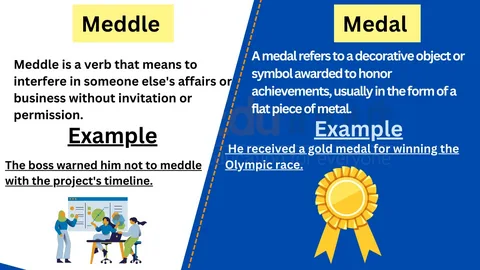
If you have ever confused medal and meddle, you are not alone. These two words look and sound remarkably similar, especially in American English. However, their meanings are completely different. A medal is usually an award or piece of metal given for achievement, bravery, service, or winning a competition. Meddle is a verb that means to interfere in something that does not concern you. The confusion becomes even more interesting because medal can also work as a verb in sports, meaning to win a medal. In this guide, you will learn the meanings, grammar, pronunciation, examples, common mistakes, and practical rules that make the difference easy to remember.
Medal vs. Meddle: Quick Answer
Medal usually means an award, honor, or physical decoration. Meddle means to interfere in someone else’s affairs or to tamper with something, so you should choose the word based on the context.
Quick Comparison Table
| Word | Part of Speech | Main Meaning | Example |
| Medal | Noun | An award or decoration | She won a gold medal. |
| Medal | Verb | To win a medal | He medaled in the final. |
| Meddle | Verb | To interfere or intrude | Don’t meddle in my business. |
The key difference is simple: medal relates to awards and achievement, while meddle relates to interference. Major dictionaries, including Oxford and Cambridge, recognize both the noun and sports-related verb uses of medal.
Easiest Way to Remember the Difference
Think of a medal as something you can win, earn, receive, or display. Think of meddle as something you do when you interfere where you should not.
A useful memory trick is “medal = achievement, meddle = interference.” If the sentence involves a race, award, bravery, or recognition, medal is probably the right choice. If it involves interfering in someone’s affairs or touching something carelessly, meddle is the better word.
What Does “Medal” Mean?
The word medal usually refers to a flat piece of metal, often shaped like a coin, that recognizes an achievement, victory, bravery, service, or special event. For example, athletes may receive gold, silver, or bronze medals after a competition. Oxford and Cambridge both define medal in connection with awards and recognition.
In American English, you will commonly see medal in sports, military, academic, and achievement-related contexts. You can win a medal, earn a medal, receive a medal, or be awarded a medal. The word can also appear in informal expressions such as “You deserve a medal,” meaning someone deserves admiration for doing something difficult.
Medal Definition and Meaning
As a noun, medal means a metal object given as a reward or honor. It may recognize victory in a competition, bravery, military service, achievement, or another significant accomplishment.
For example, The swimmer won a gold medal at the national championship. Here, medal identifies the physical award associated with the athlete’s achievement.
Medal as a Noun
The noun medal is the most familiar use of the word. It can describe an Olympic medal, military medal, academic medal, commemorative medal, or another formal decoration.
You will often see it after verbs such as win, earn, receive, award, collect, and wear. For example, She received a medal for her years of service. This noun pattern is common in both formal and everyday American English.
Medal as a Verb
One detail that many learners miss is that medal can also be a verb. In sports, to medal means to win a medal in a competition. Oxford’s American English dictionary gives examples such as an athlete who medaled in tennis.
In U.S. English, the past tense is commonly written medaled, as in She medaled in two events. This usage is especially common in sports reporting and competition-related writing.
Common Contexts for Medal
You can use medal when discussing sports competitions, military recognition, bravery, service, academic achievements, or commemorative awards. Common combinations include gold medal, silver medal, bronze medal, Olympic medal, military medal, and medal for bravery.
The word can also describe the person who receives such an award. In American English, medalist means someone who has received a medal, especially in a sports competition.
Examples of Medal in American English
Here are some natural examples:
- The runner won a gold medal in the 400-meter race.
- Her grandfather received a medal for his military service.
- The school awarded Maya a medal for academic achievement.
- He proudly displayed his Olympic medal.
- The athlete medaled in both events.
- She hopes to win a medal at the next championship.
Notice that the first five noun examples refer to an award or recognition, while medaled is the sports-related verb.
What Does “Meddle” Mean?
Meddle is a verb meaning to interfere in something that does not concern you. It can describe unwanted involvement in another person’s affairs, relationships, decisions, or business. It can also mean handling or changing something carelessly when you do not understand it.
The word usually carries a negative or disapproving tone. For example, if you tell someone, Don’t meddle in my personal affairs, you are telling them to stop interfering in matters that belong to you.
Meddle Definition and Meaning
To meddle means to become involved in a situation when you do not have a proper reason or responsibility to be involved. It is closely related to words such as interfere, intrude, and tamper.
For example, My neighbor keeps meddling in our family decisions suggests that the neighbor is interfering in private matters.
Meddle as a Verb
Meddle is a verb, and it is normally used as an intransitive verb. Common forms include meddles, meddled, and meddling. Oxford lists meddle in and meddle with as common patterns.
For example, you can say He meddled in their relationship or She meddled with the computer settings. The first concerns unwanted involvement in people’s affairs. The second concerns careless or inappropriate handling of something.
What Does “Meddle In” Mean?
Meddle in means to interfere in a situation, activity, or person’s affairs when you should not be involved. It commonly appears with phrases such as meddle in someone’s affairs, meddle in family matters, or meddle in someone’s business.
For example, I wish my brother would stop meddling in my personal decisions. The phrase clearly suggests unwanted involvement.
What Does “Meddle With” Mean?
Meddle with can mean interfering with something or handling it carelessly, especially when you do not know how it works. Oxford gives examples involving computers and editorial policy, while Cambridge also lists meddle with things you do not understand.
For example, Don’t meddle with the settings unless you know what they do. Here, meddle with refers to inappropriate or careless interference with a thing rather than someone’s personal affairs.
Examples of Meddle in American English
Consider these examples:
- Please don’t meddle in my relationship.
- He always meddles in other people’s business.
- Her parents keep meddling in her career decisions.
- Don’t meddle with the office computer.
- The technician warned us not to meddle with the settings.
- She accused her coworker of meddling in the project.
In each example, meddle describes interference rather than achievement or recognition.
Medal vs. Meddle: What Is the Main Difference?
The main difference is meaning. Medal refers primarily to an award or decoration, while meddle refers to interference. They may appear similar on the page, but they perform very different jobs in a sentence.
There is also an important grammatical distinction. Medal can be a noun and, in sports usage, a verb. Meddle is a verb. This means you should not treat the two words as interchangeable simply because they can sound alike in American English.
Difference in Meaning
A medal represents recognition, achievement, victory, bravery, or service. A meddle describes unwanted involvement or interference.
Compare these sentences:
The athlete won a medal.
The coach told the parent not to meddle in the team’s decisions.
The first sentence involves an award. The second involves interference.
Difference in Part of Speech
Medal is commonly a noun, but it can also be a verb in sports. Meddle is a verb.
This distinction matters because sentence structure changes with the word’s grammatical role. You can receive a medal, but you can meddle in someone’s affairs. You can also say She medaled in swimming when describing a sports achievement.
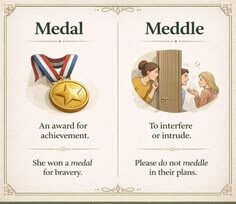
Difference in Context and Usage
Context usually makes the correct word obvious. Sports, awards, bravery, service, and recognition point toward medal. Personal affairs, unwanted involvement, interference, and careless handling point toward meddle.
For example, The soldier received a medal for bravery is correct. The soldier received a meddle for bravery is incorrect because meddle does not mean an award.
Are Medal and Meddle Pronounced the Same?
In American English, medal and meddle are commonly pronounced the same or extremely similarly. Cambridge lists both with the American pronunciation /ˈmed.əl/, while Oxford gives the American form /ˈmɛdl/.
That similarity explains much of the confusion. When speaking, listeners usually rely on context to distinguish the words. In writing, however, the spelling must communicate the intended meaning.
Why These Words Are Commonly Confused
The words share nearly identical spelling and pronunciation, but their meanings have little in common. English has many such confusing word pairs where sound alone cannot tell you which spelling to use.
The easiest solution is to identify the meaning before writing the word. If you mean an award, choose medal. If you mean interference, choose meddle.
Medal vs. Meddle vs. Metal vs. Mettle
English contains another pair that can make this group even more confusing: metal and mettle. Although these four words sound similar, each has a distinct meaning.
| Word | Main Meaning | Part of Speech | Example |
| Medal | Award or decoration | Noun / Verb | She won a medal. |
| Meddle | Interfere or intrude | Verb | Don’t meddle in their affairs. |
| Metal | Chemical element or material | Noun | The bridge contains metal. |
| Mettle | Courage and determination | Noun | The challenge tested his mettle. |
This four-word comparison can prevent several common spelling mistakes.
Medal — An Award or Honor
Medal refers to an award or decoration, especially one associated with achievement, bravery, service, or competition. Olympic medals and military decorations are familiar examples.
Meddle — To Interfere
Meddle means to interfere in something that is not your responsibility or to handle something carelessly. It is usually disapproving in tone.
Metal — A Material or Chemical Element
Metal refers to a chemical element or a mixture of such elements, such as iron, gold, or steel. It is a material rather than an award or action.
Mettle — Courage and Determination
Mettle means a person’s ability, courage, and determination when facing something difficult. For example, The difficult final tested the athlete’s mettle.
Quick Comparison of All Four Words
A simple way to separate them is to connect each word with one idea: medal = award, meddle = interfere, metal = material, mettle = courage.
Once you attach those meanings to the spellings, the four words become much easier to recognize.
When Should You Use Medal or Meddle?
Use medal when your sentence involves an award, competition, bravery, service, or achievement. Use meddle when the sentence involves interference or unwanted involvement.
The important point is that you should choose based on meaning rather than pronunciation. Since the words can sound alike in American English, listening alone may not help you make the correct spelling choice.
Use Medal for Awards, Honors, and Achievements
Choose medal when someone receives recognition in the form of a medal. This includes athletic awards, military decorations, bravery awards, and certain academic or commemorative honors.
For example, The firefighter received a medal for bravery uses the word correctly because the sentence describes formal recognition.
Use Medal as a Verb in Competition Contexts
You can use medal as a verb when describing an athlete who wins a medal. For example, The American runner medaled in the 800-meter event.
This sports-related verb is recognized in major dictionaries, including Oxford and Cambridge. In U.S. English, medaled is a standard past-tense spelling.
Use Meddle for Unwanted Interference
Choose meddle when someone interferes in something that is not their responsibility. The situation might involve family, relationships, work, business, or personal decisions.
For example, You should not meddle in their marriage means you should not interfere with their relationship.
Use “Meddle In” for Other People’s Affairs
Use meddle in when you become unnecessarily involved in a situation or someone’s affairs.
Examples include:
- Don’t meddle in my personal affairs.
- She keeps meddling in family matters.
- He should stop meddling in office politics.
The pattern meddle in + matter/affair/situation is well established in English usage.
Use “Meddle With” for Things, Systems, or Equipment
Use meddle with when the unwanted interference involves an object, system, equipment, or another thing.
For example, Don’t meddle with the electrical controls warns someone not to interfere with equipment they may not understand. Oxford specifically gives meddling with her computer as an example of this use.
A Simple Context Test for Choosing the Right Word
Ask yourself one question: “Am I talking about an award or interference?”
If the answer is an award, achievement, or competition, use medal. If the answer is interference, use meddle. This simple test works even when the two words sound identical.
Common Mistakes With Medal and Meddle
Most mistakes happen because writers remember the sound but forget the meaning. Since medal and meddle can sound alike in American English, spelling becomes especially important in writing.
A second common mistake is assuming that medal can only be a noun. Sports writing regularly uses it as a verb, so sentences such as She medaled in two events are perfectly valid.
Using Meddle When You Mean Medal
Incorrect: The runner won a gold meddle.
Correct: The runner won a gold medal.
The sentence describes an award, so medal is required.
Using Medal When You Mean Meddle
Incorrect: Stop medaling in my personal affairs.
Correct: Stop meddling in my personal affairs.
The sentence describes interference, so meddling is the correct form.
Assuming Medal Is Always a Noun
It is incorrect to say that medal is always a noun. Dictionaries recognize medal as a verb meaning to win a medal in a competition.
For example, She medaled in tennis last year uses medaled as a verb.
Confusing Similar-Sounding Words
You may also confuse medal, meddle, metal, and mettle because their pronunciations overlap in many varieties of English.
Instead of memorizing their sounds, memorize their meanings: award, interfere, material, and determination.
Incorrect and Correct Sentence Examples
| Incorrect | Correct |
| He won a silver meddle. | He won a silver medal. |
| Don’t medal in my business. | Don’t meddle in my business. |
| She meddled in the race and won. | She medaled in the race. |
| The medal is made of iron. | The medal is made of metal. |
| The difficult race tested his medal. | The difficult race tested his mettle. |
These examples show why context is more useful than pronunciation when choosing the spelling.
Medal vs. Meddle Examples in Real Sentences
Real sentences make the distinction easier because they show how each word behaves naturally.
In everyday American English, medal often appears in conversations about sports, military service, awards, and accomplishments. Meddle appears when people discuss interference, boundaries, relationships, or careless handling of things.
Examples With Medal
- She won a bronze medal at the state championship.
- His medal was displayed in a glass case.
- The school gave him a medal for academic achievement.
- The veteran received a medal for his service.
- Winning an Olympic medal was her lifelong goal.
These examples use medal as a noun because the word identifies an award or decoration.
Examples With Medal as a Verb
- The swimmer medaled in two events.
- She medaled at the national championships.
- The team hopes to medal this season.
- He medaled in the long jump.
In these sentences, medal describes the act of winning a medal in competition. This sports usage is documented by Oxford and Cambridge.
Examples With Meddle
- Don’t meddle in their personal relationship.
- He tends to meddle in office disputes.
- She was accused of meddling in the project.
- Parents sometimes meddle in their adult children’s decisions.
Each example describes unwanted involvement.
Examples With “Meddle In”
- Please don’t meddle in my family affairs.
- He should not meddle in their financial decisions.
- Why does she always meddle in other people’s business?
- The manager warned employees not to meddle in another team’s work.
The phrase emphasizes involvement in a situation or person’s affairs.
Examples With “Meddle With”
- Don’t meddle with the machine.
- He meddled with the computer settings.
- She told the children not to meddle with the controls.
- Someone had been meddling with the equipment.
Here, meddle with focuses on interfering with or carelessly handling a thing.
Medal vs. Meddle Examples in Everyday USA English
Imagine two coworkers discussing a recent competition. One says, “Jordan won a medal.” That statement describes an achievement.
Now imagine the same coworkers discussing workplace boundaries. One says, “Jordan keeps meddling in our project.” That statement describes unwanted involvement.
The spelling changes because the meaning changes, even though the words can sound almost identical.
Medal vs. Meddle: Grammar Guide and Usage Tips
Understanding the grammar behind these words makes correct usage much easier. Medal can function as a noun or a sports-related verb. Meddle functions as a verb and commonly appears with in or with.
When you understand the sentence role, you can often spot the correct spelling before you finish writing the sentence.
Parts of Speech and Sentence Roles
As a noun, medal names a thing: She received a medal. As a verb, medal describes an athletic achievement: She medaled in swimming. Meddle is a verb: He meddled in their affairs.
Common Grammar Patterns With Medal
Common noun patterns include win a medal, receive a medal, earn a medal, award a medal, and wear a medal. As a verb, you can use medal in + competition/event.
For example, She won a medal in gymnastics uses the noun, while She medaled in gymnastics uses the verb.
Common Grammar Patterns With Meddle
The most useful patterns are meddle in + affairs/matters/business and meddle with + thing/equipment/system.
For example, Don’t meddle in my personal affairs involves people or matters. Don’t meddle with the controls involves a thing. Oxford specifically recognizes both patterns.
Pronunciation and Spelling Tips
In American English, medal and meddle are commonly pronounced alike or nearly alike. That makes them a classic example of words whose written forms carry the meaning more clearly than their sounds.
When writing, focus on the meaning. Medal contains the spelling associated with the award, while meddle has the double d associated with the verb meaning to interfere.
Memory Tricks for Remembering Medal vs. Meddle
Try this simple connection: medal = something you can win; meddle = something you should avoid doing unnecessarily.
Another trick is to associate meddle with interfere. Both describe getting involved where you may not belong. Associate medal with award, competition, or achievement.
Formal, Informal, and Everyday Usage
Both words are common in standard English, but their contexts differ. Medal appears frequently in sports, military, academic, and award-related writing. Meddle appears in everyday conversations as well as formal writing about interference or inappropriate involvement.
The expression “You deserve a medal” can also be informal and humorous. Oxford notes that it may express admiration for someone who has done something difficult or unpleasant.
Medal vs. Meddle Practice Quiz
Test yourself before moving on. Choose medal or meddle in each sentence.
Fill-in-the-Blank Questions
- The swimmer won a gold ______.
- Please do not ______ in their personal affairs.
- She ______ in two events last year.
- He received a ______ for bravery.
- Stop ______ with the computer settings.
- The athlete hopes to win another ______.
- His parents should not ______ in his career decisions.
- The runner ______ in the final event.
- The soldier proudly wore his ______.
- Don’t ______ in matters that do not concern you.
Choose Medal or Meddle
The correct answers are:
- medal
- meddle
- medaled
- medal
- meddle
- medal
- meddle
- medaled
- medal
- meddle
The fastest way to solve these is to look at the meaning. Awards and sports achievements point toward medal. Interference points toward meddle.
Identify the Correct Usage
Consider these pairs:
A: She won a meddle.
B: She won a medal.
The correct sentence is B because the object is an award.
Now compare:
A: Don’t medal in my personal affairs.
B: Don’t meddle in my personal affairs.
The correct sentence is B because the verb describes interference.
Answers With Explanations
The noun medal fits sentences about awards, while the verb meddle fits sentences about interference. When a sentence describes an athlete winning a medal, medal can also function as a verb.
This distinction follows the dictionary definitions rather than a simple spelling rule. Oxford and Cambridge both recognize the sports verb medal.
Final Takeaway: Medal vs. Meddle
The difference between medal vs. meddle becomes easy once you connect each spelling with its meaning. Medal refers to an award or decoration and can also mean to win a medal in a competition. Meddle means to interfere, intrude, or handle something carelessly.
Medal = Award or Achievement
Use medal for a physical award, recognition, bravery decoration, competition prize, or sports achievement. You can also use it as a verb in sports: The athlete medaled in two events.
Meddle = Interfere or Intrude
Use meddle when someone interferes in another person’s affairs or tampers with something. The most common patterns are meddle in and meddle with.
One-Line Rule to Remember the Difference
Medal is something you can win; meddle is something you do when you interfere.
Frequently Asked Questions About Medal vs. Meddle
What is the difference between medal and meddle?
Medal means an award or, in sports, to win an award. Meddle means to interfere in someone’s affairs or tamper with something.
Is medal a noun or a verb?
It can be both. It is usually a noun for an award, but it is also a sports verb meaning to win a medal.
Is meddle a noun or a verb?
Meddle is a verb. Its main meaning is to interfere in something that does not concern you.
Are medal and meddle pronounced the same?
In American English, they are commonly pronounced the same or very similarly, which helps explain why writers confuse them.
Can medal and meddle be used interchangeably?
No. They have different meanings and grammatical functions. Use medal for awards or sports achievement and meddle for interference.
What does meddle in mean?
Meddle in means to interfere in a person’s affairs, activity, or situation when you are not responsible for it.
What does meddle with mean?
Meddle with means to interfere with or handle something carelessly, especially when you do not understand it.
Why do people confuse medal and meddle?
They are commonly pronounced alike or almost alike in American English, and their spellings differ by only one letter. Context provides the key distinction.
What is the difference between medal, meddle, metal, and mettle?
Medal is an award, meddle means interfere, metal is a material or chemical element, and mettle means courage and determination.
What is another word for meddle?
Depending on the context, alternatives include interfere, intrude, and tamper. The best choice depends on whether you mean involvement in affairs or interference with a thing.
How can I remember the difference between medal and meddle?
Remember this four-word shortcut: medal = award, meddle = interfere, metal = material, mettle = courage.
Conclusion
Choosing the correct word becomes straightforward when you focus on meaning instead of sound. Medal relates to awards, recognition, competition, bravery, and achievement. Meddle describes unwanted interference or careless involvement.
If you are writing about an Olympic award, military honor, or sports achievement, choose medal. If someone is interfering in your personal affairs or tampering with equipment, choose meddle. Once you learn those two core meanings, this commonly confused pair becomes much easier to spell and use correctly.




[…] once you understand how the phrase works. In this guide, you will learn the correct spelling, meaning, grammar, punctuation, common mistakes, and practical […]