
Stars can turn an ordinary night into something unforgettable. They can look delicate, distant, bright, mysterious, or almost magical. That is why similes to describe stars are useful in poems, stories, essays, captions, and other forms of creative writing.
A good simile gives your reader a clear picture without making the sentence difficult. You can compare stars with diamonds, pearls, fireflies, lanterns, candles, or sparks. The best star imagery does more than describe brightness. It also creates emotion, atmosphere, and meaning.
Whether you are writing about a quiet starry sky, a romantic night sky, or distant shooting stars, the right comparison can make your words shine. This guide gives you beautiful star similes, meanings, examples, writing tips, and ideas for creating your own original comparisons.
What Is a Simile to Describe Stars?
A simile is a form of figurative language that compares one thing with another by using words such as “like” or “as.” For example, “The stars glittered like diamonds” compares the appearance of stars with the sparkle of diamonds. Cambridge Dictionary’s definition of simile
In descriptive writing, a star simile helps you show an image instead of simply stating a fact. “The stars were bright” gives basic information. “The stars shone like tiny lanterns” creates stronger visual imagery. The second sentence gives your reader something familiar to imagine, which makes the description more vivid, relatable, and effective.
Simple Definition of a Star Simile
A star simile compares a star or group of stars with something familiar. The comparison usually focuses on one shared quality, such as light, sparkle, movement, beauty, or distance. For example, “The stars twinkled like fireflies” connects their flicker with the movement of fireflies.
Simile vs. Metaphor: The Basic Difference
A simile makes the comparison openly by using “like” or “as.” A metaphor makes a more direct comparison. “The stars were like diamonds” is a simile, while “The stars were diamonds” is a metaphor. Cambridge Dictionary’s definition of metaphor
Example of a Star Simile
Consider this sentence: “The stars glittered like silver dust across the black velvet of the sky.” The comparison focuses on delicate sparkle and contrast. It turns a simple observation into poetic imagery that gives the reader a stronger mental picture.
Quick List of Beautiful Similes to Describe Stars
Sometimes you need a quick idea before writing a sentence. The following similes for stars give you several directions. Some focus on beauty and brightness, while others suggest mystery and wonder, hope and inspiration, or guidance and warmth.
| Star Simile | What It Suggests |
| Like scattered diamonds | brightness and beauty |
| Like pearls on black velvet | elegance and contrast |
| Like tiny lanterns | guidance and warmth |
| Like distant candles | soft light |
| Like glowing fireflies | movement and sparkle |
| Like silver dust | delicate starlight |
| Like sparks from a fire | energy and intensity |
| Like jewels in a crown | grandeur |
| Like windows in darkness | mystery |
| Like quiet wishes | hope |
| Like ancient eyes | mystery and timelessness |
| Like tiny flames | warmth |
| Like beads on a necklace | arrangement |
| Like hidden treasures | discovery |
| Like cosmic freckles | playful beauty |
| Like distant beacons | guidance |
| Like polished gems | brilliance |
| Like whispers of light | subtle beauty |
| Like dreams that refused to fade | hope and persistence |
These star comparisons can work in many forms of writing. You can use them in poetry, fiction, personal essays, school assignments, or short captions. The key is to choose a comparison that matches the context, tone, and mood of your sentence.
35+ Similes to Describe Stars With Meanings and Examples
The strongest similes to describe stars do not all focus on sparkle. A star can suggest beauty, movement, distance, mystery, hope, or memories. The examples below cover these different qualities so you can choose comparisons for stars that fit your exact scene.
Similes for the Appearance of Stars
The appearance of stars changes with their brightness, color, position, and surroundings. In celestial writing, you can focus on their scattered pattern or their contrast against a dark sky. Comparisons with diamonds, pearls, gems, and beads work well when you want an elegant image.
| # | Simile | Meaning | Example |
| 1 | Like scattered diamonds | Bright points against darkness | The stars looked like scattered diamonds across the sky. |
| 2 | Like pearls on black velvet | Soft elegance | The stars rested like pearls on black velvet. |
| 3 | Like silver dust | Fine sparkle | The distant stars spread like silver dust overhead. |
| 4 | Like jewels in a crown | Grandeur | The brightest stars shone like gems in a crown. |
| 5 | Like beads on an endless necklace | Pattern and continuity | The stars stretched like beads on an endless necklace. |
| 6 | Like cosmic freckles | Playful appearance | Tiny stars dotted the heavens like cosmic freckles. |
| 7 | Like crystals on dark glass | Delicate brilliance | The stars appeared like crystals on dark glass. |
Similes for Brightness and Starlight
The brightness of stars gives you many possibilities for figurative language. A candle suggests gentle light, while a spark suggests sudden energy. A lantern suggests guidance. Choose the object according to the feeling you want your sentence to create.
| # | Simile | Meaning | Example |
| 8 | Like tiny lanterns | Warm illumination | The stars glowed like tiny lanterns above us. |
| 9 | Like distant candles | Gentle light | The stars flickered like candles far beyond the hills. |
| 10 | Like sparks from an eternal fire | Strong brilliance | The stars flashed like sparks from an eternal fire. |
| 11 | Like polished silver | Cool shine | The stars gleamed like polished silver. |
| 12 | Like golden pins | Sharp points of light | Golden stars pierced the darkness like tiny pins. |
| 13 | Like glowing embers | Warm persistence | A few stars burned like glowing embers. |
| 14 | Like pieces of crystal | Clear brilliance | The stars glittered like pieces of crystal. |
Similes for Twinkling and Movement
Twinkling stars can appear to move even though their apparent position changes only slowly. For creative purposes, you can compare their flicker with fireflies, flames, reflections, or sparks. These images create a stronger sense of movement and life.
| # | Simile | Meaning | Example |
| 15 | Like fireflies in a meadow | Flickering movement | The stars blinked like fireflies in a meadow. |
| 16 | Like candles in a breeze | Unsteady light | The stars trembled like candles in a gentle breeze. |
| 17 | Like sparks riding the wind | Quick movement | The stars flashed like sparks riding the wind. |
| 18 | Like reflections on water | Shimmering light | The stars shimmered like reflections on water. |
| 19 | Like restless eyes | Repeated blinking | The stars watched like restless eyes. |
| 20 | Like dancing drops of light | Playful movement | The stars danced like drops of light above the trees. |
Similes for Beauty and Elegance
When your goal is beauty and brightness, choose soft and graceful images. Pearls, silk, crystals, polished gems, and silver petals create a refined feeling. These beautiful star similes work especially well in romantic poetry, personal writing, and peaceful descriptions.
| # | Simile | Meaning | Example |
| 21 | Like pearls on midnight silk | Graceful beauty | The stars rested like pearls on midnight silk. |
| 22 | Like crystals sewn into velvet | Decorative beauty | The sky glittered like crystals sewn into velvet. |
| 23 | Like jewels in an ancient crown | Timeless elegance | The stars looked like jewels in an ancient crown. |
| 24 | Like silver petals | Delicate beauty | The stars opened like silver petals above the valley. |
| 25 | Like polished gems | Refined brilliance | The stars shone like polished gems. |
Similes for Mystery and Wonder
The night sky often makes people think about the universe, space, and the enormous distance between Earth and other stars. That sense of mystery and wonder can become powerful emotional imagery. Try comparisons involving secret eyes, hidden treasures, ancient messages, and distant windows.
| # | Simile | Meaning | Example |
| 26 | Like secret eyes in the dark | Mystery | The stars watched like secret eyes in the dark. |
| 27 | Like windows into eternity | Vastness | The stars looked like windows into eternity. |
| 28 | Like whispers from another world | Otherworldly feeling | The stars shimmered like whispers from another world. |
| 29 | Like hidden treasures | Discovery | The distant stars appeared like hidden treasures. |
| 30 | Like ancient messages | History and mystery | The stars seemed like ancient messages crossing time. |
Similes for Hope and Inspiration
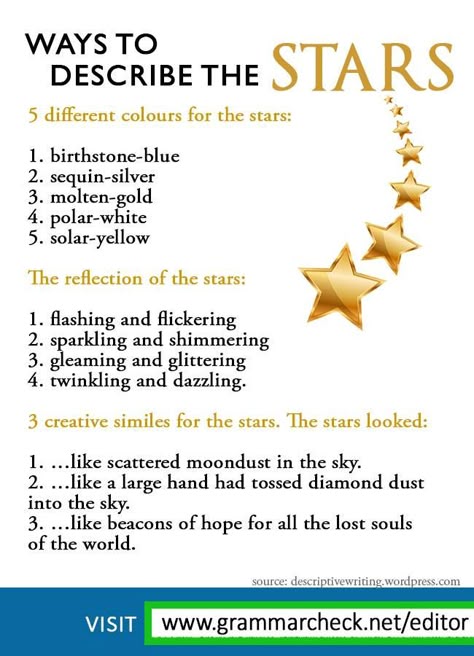
Stars often provide powerful symbolism because they appear as points of light against darkness. That contrast makes them useful for expressing hope and inspiration. A beacon can suggest direction, while a small spark can represent hope that survives difficult circumstances.
| # | Simile | Meaning | Example |
| 31 | Like beacons in darkness | Guidance | The stars stood like beacons in darkness. |
| 32 | Like sparks of hope | Encouragement | The stars glowed like sparks of hope. |
| 33 | Like distant promises | Optimism | The stars shone like distant promises. |
| 34 | Like candles leading travelers home | Direction | The stars looked like candles leading travelers home. |
| 35 | Like dreams refusing to fade | Persistence | The stars lingered like dreams refusing to fade. |
| 36 | Like quiet wishes | Longing | The stars floated above us like quiet wishes. |
| 37 | Like memories in the distance | Reflection | The stars remained like memories in the distance. |
Best Star Similes for Different Writing Styles
Not every comparison belongs in every type of writing. A school essay usually needs clarity, while a poem can use richer imagery. A fantasy story can be more magical, while a serious essay may need restrained language. Your best creative star similes should match the purpose of the passage.
The same star can therefore create very different effects. A candle can suggest warmth, a jewel can suggest beauty, and a beacon can suggest guidance. When you understand the tone and context, your star descriptions become more natural and effective.
Poetic Similes for Stars
Poetic writing allows more freedom with sound, rhythm, and layered meaning. Try comparisons such as “stars like whispers caught in darkness” or “stars like silver petals drifting through the heavens.” These poetic imagery choices can create a softer emotional connection.
Romantic Similes for Stars
Romantic writing often benefits from gentle star imagery. You might describe stars as “like promises written across the heavens” or “like tiny jewels surrounding the moon.” Such comparisons can suggest affection, shared memories, longing, and admiration.
Magical and Dreamy Star Similes
Fantasy writing welcomes unusual comparisons. Try describing stars as “like enchanted seeds scattered across the heavens” or “like tiny doors glowing in the cosmic dark.” These magical images give ordinary scenery a dreamlike quality.
Simple Similes for Students
Students often need clear similes for stars that are easy to understand. “The stars were like diamonds” is simple. “The stars twinkled like fireflies” adds movement. These examples work well in school essays, classroom exercises, and basic creative writing.
Dramatic and Powerful Star Similes
For dramatic scenes, choose powerful star similes involving flames, sparks, burning embers, or signals. “The stars flashed like sparks above the battlefield” feels much stronger than a gentle comparison with pearls.
Short Star Similes for Captions
Short captions need quick visual impact. Phrases such as “stars like scattered jewels,” “stars like midnight fire,” and “stars like tiny dreams” can work well. Keep the image compact when the photograph already provides much of the visual imagery.
How to Use Similes to Describe Stars in Writing
A useful comparison should support the sentence rather than compete with it. Before choosing among different similes to describe stars, decide what you want the reader to notice. It might be brightness, distance, movement, beauty, mystery, or emotion.
Good descriptive writing also considers the surrounding scene. A peaceful field needs different imagery from a stormy battlefield. The right star simile should feel as though it belongs naturally inside the scene instead of appearing as an ornament.
Match the Simile to the Scene
A calm countryside might suit “stars like distant candles.” A tense scene might need “stars like sparks above a dark horizon.” The physical setting should guide your comparison.
Match the Comparison to the Emotion
Every comparison carries an emotional suggestion. Candles can communicate warmth, while embers can suggest endurance. Beacons can suggest guidance, and pearls can suggest elegance.
Choose a Clear and Familiar Image
A familiar object gives the reader an instant mental picture. Diamonds, candles, fireflies, lanterns, and sparks are easy to visualize. Originality matters, but clarity should come first.
Avoid Repeating the Same Comparison
Using “diamonds” once can be effective. Using diamonds in every paragraph becomes a cliché. Try switching between texture, movement, brightness, emotion, and distance.
Use Similes Naturally
A paragraph does not need a simile in every sentence. Too much figurative language can make a passage feel crowded. One carefully chosen image can create more emotional impact than several weak comparisons.
Similes for Different Types of Stars and Sky Scenes
Different celestial scenes need different forms of star imagery. A North Star suggests direction, while shooting stars suggest movement. The Milky Way suggests scale and abundance. A red giant invites warmer and more dramatic imagery.
Similes for the North Star
The North Star, or Polaris, works especially well for comparisons about direction. You might describe it as “like a lighthouse above the horizon,” “like a steady lantern for travelers,” or “like a fixed jewel guiding the night.”
Similes for a Shooting Star
Shooting stars invite energetic comparisons. You can describe one as “like a silver arrow,” “like a spark racing through darkness,” or “like a streak of fire across black silk.” These images emphasize speed and fleeting beauty.
Similes for the Milky Way
The Milky Way can be compared with a river, glowing trail, silver road, or spilled dust. These celestial imagery choices emphasize scale, texture, and the impression of countless distant lights.
Similes for a Starry Night Sky
A full starry sky can resemble “a black velvet curtain covered with gems” or “an endless field of fireflies.” Such comparisons emphasize abundance and contrast.
Similes for a Red Giant
A red giant can inspire comparisons with enormous embers, glowing furnaces, or giant coals. These powerful images emphasize heat, color, scale, and intensity.
Similes for Faint or Distant Stars
Distant stars work well with subtle comparisons. Try “like fading embers beyond the hills,” “like pale beads in fog,” or “like whispers of light.” These images create a quiet and delicate mood.
Why Do Similes to Describe Stars Make Writing Better?
Good similes to describe stars give abstract ideas a physical form. Instead of simply saying the stars are beautiful, you can show exactly what their beauty resembles. This makes the sentence more vivid and gives the reader something familiar to imagine.
A strong comparison can also change the entire atmosphere of a scene. The stars may become comforting lanterns, mysterious eyes, delicate pearls, or hopeful sparks. The object you choose quietly shapes the mood, tone, and emotional impact of the passage.
They Create Vivid Imagery
A comparison turns a distant point of light into something familiar. “The stars glittered like crushed glass” gives the reader an immediate picture of sparkle and scattered brightness.
They Add Emotion and Atmosphere
The comparison can change the feeling of a scene. Stars like candles feel peaceful. Stars like sparks feel energetic. Stars like distant eyes feel mysterious.
They Make Abstract Ideas Easier to Picture
Ideas such as vastness, infinity, distance, and hope can be difficult to describe directly. A good comparison gives those ideas a tangible shape that readers can understand.
They Help Readers Remember a Description
“The stars were beautiful” is clear but ordinary. “The stars glittered like silver dust across black velvet” is more specific. Strong imagery can make a sentence stay in the reader’s mind.
Common Mistakes When Writing Star Similes
Even beautiful star similes can become weak when writers overuse them. The goal is not to decorate every sentence. The goal is to choose an image that adds meaning, clarity, or emotion.
Strong literary writing balances figurative language with plain statements. Sometimes a simple sentence gives the reader space to breathe. Then one carefully selected comparison can create the strongest effect.
Overusing “Like Diamonds”
Diamonds are a natural comparison because stars can look bright and jewel-like. However, the image becomes predictable when every star is described as a diamond. Try pearls, sparks, fireflies, lanterns, or silver dust instead.
Mixing Similes and Metaphors
A simile says, “The stars were like diamonds.” A metaphor says, “The stars were diamonds.” Both are useful, but mixing them carelessly can weaken your writing.
Using Unrelated Comparisons
An unusual comparison is not automatically an original comparison. Your image should have a clear connection with the stars. If readers cannot understand the shared quality, the sentence may feel forced.
Repeating the Same Image
If one paragraph uses jewels, try a different kind of image later. You can shift from objects to movement, emotion, texture, or distance. This creates richer star imagery.
Using Too Many Similes
Several similes in one paragraph can overwhelm the reader. Let your strongest comparison stand out. Good descriptive writing needs rhythm and breathing room.
Ignoring the Mood and Context
A peaceful scene might need delicate, elegant, and magical imagery. A dramatic scene might need powerful, fiery, or dramatic comparisons. Always consider the mood before choosing your image.
Similes vs. Metaphors for Stars: What’s the Difference?
A simile and a metaphor both create figurative comparisons, but they do so differently. Cambridge Dictionary defines a simile as a comparison using “like” or “as,” while a metaphor describes something through another thing with similar characteristics. Cambridge Dictionary: Simile and Metaphor
For creative writing, both devices are useful. A simile often makes the relationship clearer. A metaphor can make the image feel more direct. The best choice depends on your tone, purpose, and the effect you want your reader to experience.
| Feature | Simile | Metaphor |
| Basic purpose | comparison | Direct comparison |
| Common signal | Like or as | Is or are |
| Star example | Stars shine like diamonds. | Stars are diamonds. |
| Main effect | Clear and familiar | Direct and forceful |
| Useful for | Explanation and description | Poetry and literary writing |
Star Simile Examples
Examples include “The stars shone like diamonds,” “The stars twinkled like fireflies,” and “The stars glowed like tiny lanterns.” Each sentence clearly tells the reader how the comparison works.
Star Metaphor Examples
Metaphors can be more direct. “The stars were diamonds across the sky” removes the word “like.” “The night was a velvet curtain” also creates a direct figurative image.
When to Use a Simile
Use a simile when you want the comparison to be obvious. It works especially well for students, beginners, essays, explanations, captions, and straightforward descriptive writing.
When to Use a Metaphor
Use a metaphor when you want the image to feel stronger or more integrated into the sentence. Poetry, fiction, and other forms of literary writing often benefit from this direct style.
How to Create Your Own Original Star Similes
Creating your own creative star similes becomes easier when you begin with an idea instead of a fancy word. Decide what you want to show first. Then find an object that shares that quality.
Think about the appearance, brightness, movement, distance, or emotional meaning of the stars. Once you identify the shared feature, connect the two images with “like” or “as.” This simple process can produce fresh similes for stars.
Step 1: Decide What You Want to Describe
Choose one quality first. You might focus on brightness, movement, color, distance, beauty, mystery, or hope. A narrow focus makes the comparison easier to control.
Step 2: Choose a Familiar Comparison
Think about familiar objects that share the quality. For brightness, consider candles, lanterns, crystals, sparks, or polished metal. For movement, consider fireflies or reflections.
Step 3: Find a Shared Quality
Ask why your two things belong together. Perhaps both glow, flicker, sparkle, move, or appear against darkness. This shared feature becomes the bridge between the star and your comparison.
Step 4: Connect It With “Like” or “As”
Now form the sentence. For example: “The stars shimmered like frost on dark glass.” The word “like” makes the simile clear.
Step 5: Match the Tone to Your Writing
A fantasy story can use magical comparisons. A school essay may need simpler language. A romantic poem can use softer and more emotional imagery. Always match the tone to the passage.
Step 6: Make the Image Fresh and Specific
Move beyond the first obvious idea. Instead of “stars like diamonds,” try “stars like frost caught beneath moonlight.” The second image feels more specific while still showing beauty and brightness.