
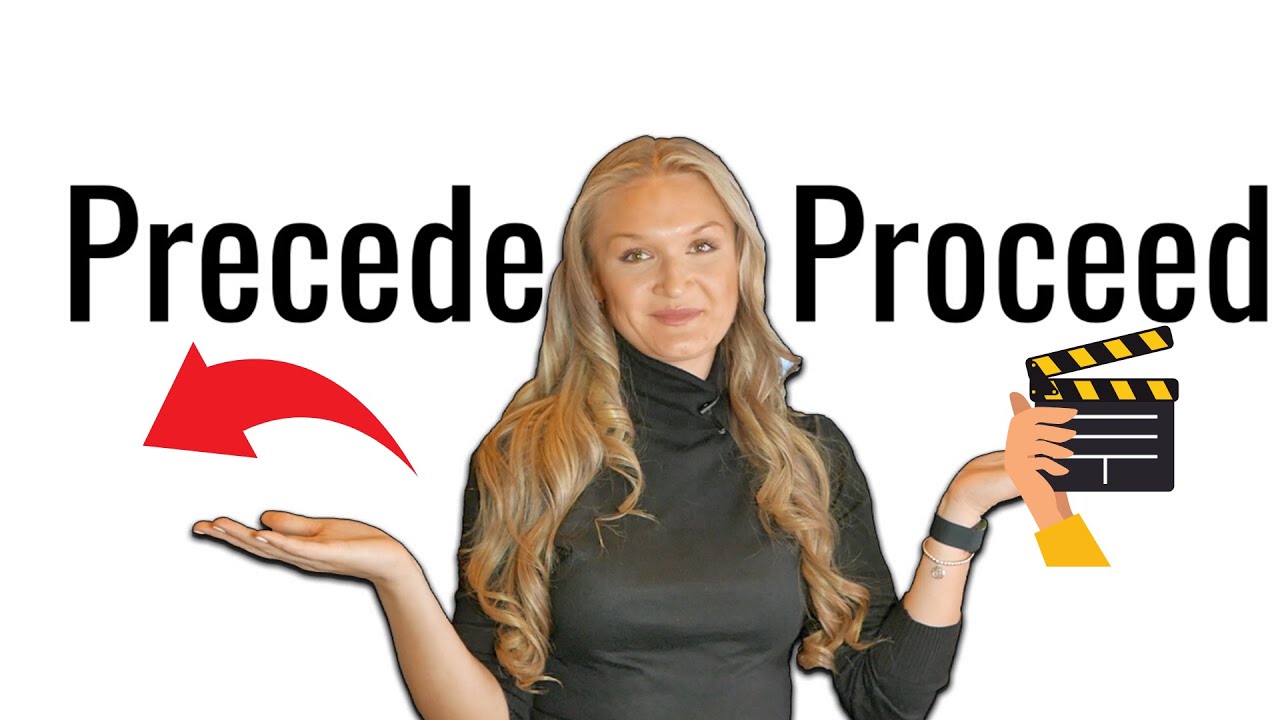
If you often hesitate between precede and proceed, you are not alone. These verbs look and sound similar, but they describe different ideas. Precede refers to something that comes before another thing in time, space, order, or sequence. Proceed means to continue, move forward, advance, or move to the next stage. The difference becomes much easier once you connect each word with its central idea. Think of precede as “before” and proceed as “forward.” In this guide, you’ll learn their meanings, grammar patterns, common mistakes, practical examples, and simple memory tricks. You’ll also see when to use “proceed with,” “proceed to,” and related forms correctly.
Precede vs. Proceed: Quick Answer
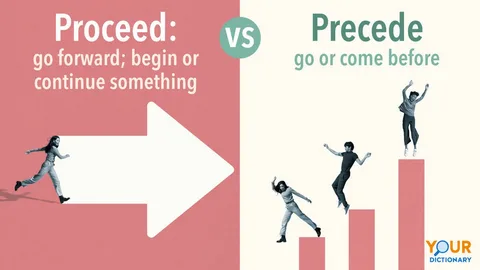
Precede means “to come before,” while proceed means “to continue or move forward.” Use precede for sequence, time, or position, and use proceed for continuing an action, advancing a process, or moving to the next stage.
| Feature | Precede | Proceed |
| Basic meaning | Come before | Continue or move forward |
| Main idea | Sequence or position | Progress or continuation |
| Common use | Events, order, time, position | Actions, processes, directions |
| Typical pattern | precede + object | proceed with/to |
| Example | The introduction preceded the speech. | Please proceed to the next step. |
What Is the Difference Between Precede and Proceed?
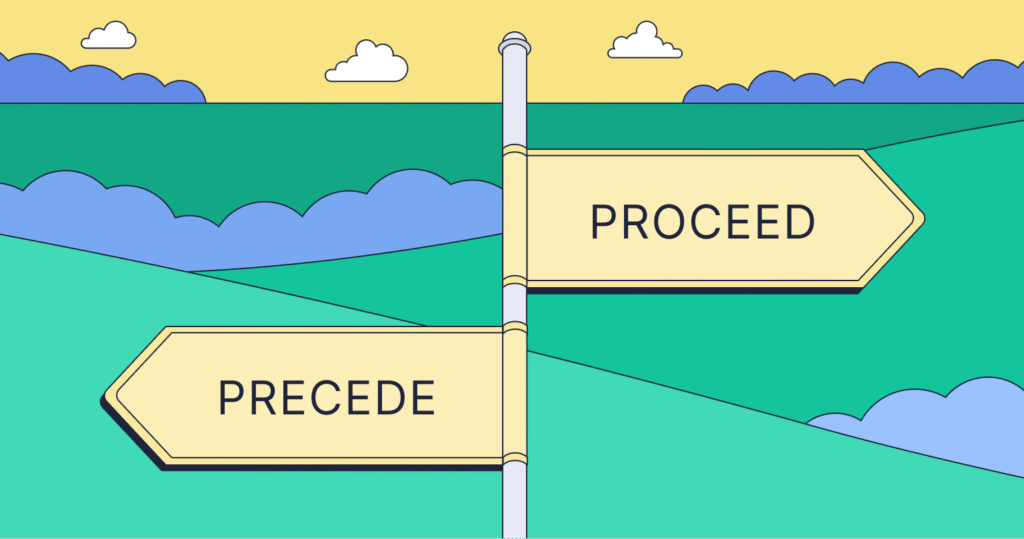
The simplest distinction is before versus forward. If one thing comes before another, you need precede. If someone continues an activity or moves to the next stage, you need proceed. This difference explains why the words cannot normally replace each other.
For example, “The introduction preceded the presentation” tells you about order. The introduction came first. By contrast, “Please proceed to the next section” gives an instruction to move forward. The two verbs may look nearly identical, but their jobs in a sentence are different.
Precede Means “Come Before”
Precede means to be or go before someone or something in time or space. It can describe events, objects, people, positions, or actions that occur earlier in a sequence. For example, “A brief introduction preceded the lecture” means the introduction happened first. The verb can also describe physical or grammatical position.
Proceed Means “Continue or Move Forward”
Proceed means to start or continue an action or process, move forward, or travel in a particular direction. You might proceed with a project, proceed to the next stage, or proceed to a location. The context tells you whether the word refers mainly to continuation, progress, or movement.
Precede vs. Proceed in Simple English
Use precede when you can replace the word with “come before.” Use proceed when you can replace it with “continue,” “move forward,” or “go on.” This substitution test works well because it focuses on meaning rather than spelling.
When to Use Precede
Use precede when you are describing something that happens or exists before another thing. It commonly appears when you discuss events, steps, chapters, actions, positions, or people in a particular sequence. Cambridge defines the verb as being or going before something or someone in time or space.
The word also works in formal and academic writing. You might say that research preceded an experiment, an introduction preceded a presentation, or one chapter precedes another. In each case, the central idea remains the same: one thing comes first.
Precede Definition and Meaning
The verb precede means “to come before” or “to go before.” It can refer to time, space, sequence, or position. It is also used when one thing introduces or comes before another in a structured arrangement.
Use Precede for Time and Sequence
Use precede when one event happens earlier than another. For example, “The warning preceded the storm” means the warning came first. Likewise, “Training preceded employment” describes the order of two stages.
Use Precede for Position or Arrangement
Precede can also describe physical or structural position. A chapter can precede another chapter, and one item can precede another on a list. English grammar provides another example because verbs commonly precede their objects in ordinary sentence structure.
Common Examples of Precede
Here are several natural examples:
- Breakfast precedes lunch.
- The introduction preceded the main discussion.
- A warning preceded the system shutdown.
- Research preceded the experiment.
- Chapter 2 precedes Chapter 3.
- The opening remarks preceded the presentation.
When to Use Proceed
Use proceed when you mean “continue,” “move forward,” or “advance.” It commonly appears in instructions, procedures, meetings, projects, and other situations where someone needs to keep going or move to another stage.
Unlike precede, proceed does not normally take a direct object in the same way. Common structures include proceed with + noun, proceed to + noun, and proceed to + verb. Cambridge specifically recognizes these patterns.
Proceed Definition and Meaning
Proceed means to start or continue an action or process. It can also mean to move forward or travel in a particular direction. For example, “The project is proceeding smoothly” describes progress, while “Please proceed to the exit” describes movement.
Use Proceed to Continue an Action
Use proceed with when you mean to continue with an activity, plan, case, project, or process.
For example:
- We decided to proceed with the project.
- The team proceeded with the investigation.
- The company will proceed with the expansion.
- You may proceed with the application.
Use Proceed to Move to the Next Step or Place
Use proceed to when someone moves to another place, stage, or point in a process.
For example:
- Please proceed to the next page.
- Passengers should proceed to Gate 12.
- The case will proceed to trial.
- After approval, we can proceed to the next stage.
Common Examples of Proceed
- Please proceed with caution.
- The meeting proceeded as planned.
- We can proceed once everyone arrives.
- After payment, proceed to checkout.
- The project proceeded smoothly.
- She proceeded to explain the situation.
Precede vs. Proceed: Key Differences in Meaning and Usage
The central difference is straightforward. Precede establishes an earlier position, while proceed describes continuation or forward movement. In other words, one looks backward in a sequence, while the other moves the action ahead.
Their grammar also differs. Precede is a transitive verb, so it can take a direct object. Proceed is an intransitive verb and commonly appears with structures such as “proceed with,” “proceed to,” or “proceed as planned.” Cambridge identifies precede as a transitive verb and proceed as an intransitive verb.
Difference in Meaning
Think of the two words this way:
Precede = come before
Proceed = continue or move forward
“The ceremony preceded the dinner” describes sequence. “The guests proceeded to dinner” describes what happened next.
Difference in Function
Precede normally describes a relationship between two things. One thing comes before another.
Proceed describes an action or process that continues or advances. It often tells someone what to do next.
Difference in Grammar
A common pattern for precede is:
Subject + precede + object
The announcement preceded the ceremony.
Common patterns for proceed include:
proceed + with + noun
We proceeded with the plan.
proceed + to + noun
Please proceed to the next room.
proceed + to + verb
She proceeded to explain the issue.
Difference in Context
Choose precede when the sentence focuses on order, timing, position, or what happened first. Choose proceed when it focuses on continuation, movement, advancement, or what happens next.
How to Use Precede and Proceed in a Sentence
Sentence structure provides another reliable way to separate these verbs. If the sentence tells you that one thing comes before another, precede usually fits. If it tells someone to continue or describes a process moving forward, proceed usually fits.
In practice, look at the words around the verb. The construction often reveals the intended meaning immediately. For example, “precede the ceremony” identifies something that comes before the ceremony. Meanwhile, “proceed with the ceremony” means to continue with it.
Precede Sentence Pattern
The basic pattern is:
Subject + precede + object
Examples include:
- The speech preceded the ceremony.
- Research preceded the experiment.
- The warning preceded the accident.
- An introduction preceded the report.
You can also use passive constructions such as “The ceremony was preceded by a short speech.”
Proceed With + Noun
Use proceed with when you want to say that someone continues an activity or plan.
Examples:
- We will proceed with the project.
- They proceeded with the investigation.
- The team proceeded with the original plan.
- You can proceed with the application.
Proceed To + Noun or Place
Use proceed to when someone moves to another location, stage, or point in a process.
Examples:
- Please proceed to the registration desk.
- Proceed to the next page.
- The case proceeded to trial.
- We can proceed to the final stage.
Proceed To + Verb
Proceed to + verb means that someone does something after completing or discussing something else. For example, “She proceeded to explain the problem” means she then explained the problem. Cambridge specifically lists this construction.
Proceed as Planned
The phrase proceed as planned means that an activity continues according to the expected plan.
For example:
Despite the delay, the event proceeded as planned.
You can also use phrases such as proceed with caution, proceed carefully, and proceed from here when the context calls for them.
Precede and Proceed Grammar Examples
Compare these sentences:
| Sentence | Meaning |
| The introduction preceded the lecture. | The introduction came first. |
| Please proceed to the lecture hall. | Move to the lecture hall. |
| The warning preceded the shutdown. | The warning happened first. |
| Please proceed with the shutdown. | Continue with the shutdown. |
The important point is that changing the verb changes the direction of the meaning.
Common Mistakes With Precede and Proceed
The most common mistake is choosing the word based on appearance rather than meaning. Because precede and proceed look and sound similar, writers sometimes use one when they need the other.
Another common error involves spelling precede as “preceed.” That spelling is incorrect in standard English. Dictionary.com identifies preceed as a misspelling and explains that the confusion may come from the spelling of proceed.
Confusing “Precede” With “Proceed”
Remember that the words answer different questions.
What comes before? → precede
What continues or moves forward? → proceed
That simple distinction prevents many errors.
Using Precede When You Mean “Continue”
Incorrect:
Please precede to the next page.
Correct:
Please proceed to the next page.
The sentence describes moving forward, so proceed is the correct verb.
Using Proceed When You Mean “Come Before”
Incorrect:
The introduction proceeded the main discussion.
Correct:
The introduction preceded the main discussion.
Here, the introduction came first, so preceded is required.
The “Preceed” Spelling Mistake
Preceed is a misspelling of precede. The correct spelling ends in -cede, not -ceed. This is easy to remember if you connect precede with related words such as preceding and precedent.
Confusing “Proceed” With “Proceeds”
Proceed is a verb meaning to continue or move forward.
Proceeds can be a noun meaning money received from a sale, event, or transaction.
For example:
The project will proceed next week.
But:
The proceeds from the auction supported the charity.
Dictionary.com specifically distinguishes this noun use from the verb proceed.
Choosing the Word Based on Sound
The two words have similar pronunciations, so hearing them alone may not always help. Instead, identify the intended meaning first.
If the idea is before, choose precede. If the idea is forward or continuing, choose proceed.
Precede vs. Proceed: Common Real-World Examples
These verbs appear in many everyday situations. You may encounter precede in academic writing, reports, timelines, and descriptions of events. You may see proceed in instructions, workplace communication, procedures, travel directions, and formal notices.
The context usually makes the difference obvious once you know what to look for. The examples below show how the same general situation can require either word.
Precede Examples in Everyday English
- The appetizer preceded the main course.
- A short announcement preceded the event.
- The introduction preceded the interview.
- The warning preceded the storm.
- The opening remarks preceded the ceremony.
Each example describes something that happened or appeared first.
Proceed Examples in Everyday English
- Please proceed to the checkout.
- You may proceed with your order.
- The meeting proceeded without interruption.
- We proceeded to the next room.
- The event proceeded as planned.
Each example involves continuation, movement, or advancement.
Precede in Academic and Professional Writing
Precede works naturally when describing the order of research, sections, presentations, or procedures.
For example:
Data collection preceded the analysis.
The literature review preceded the research methodology.
These sentences establish a sequence rather than instructing someone to continue.
Proceed in Business and Workplace Communication
Proceed is common when discussing plans, projects, investigations, meetings, or decisions.
For example:
The team decided to proceed with the proposal.
The meeting proceeded as planned.
We need approval before we proceed.
These sentences focus on an action moving forward.
Precede and Proceed in Instructions
Instructions often use proceed because they tell readers what to do next.
Please proceed to the next question.
By contrast, an explanation of the order of instructions might use precede:
The safety briefing precedes the equipment demonstration.
The first sentence directs action. The second describes sequence.
Side-by-Side Examples
| If you mean… | Use | Example |
| Something comes first | Precede | The introduction precedes the report. |
| Something continues | Proceed | The meeting will proceed. |
| An event happens earlier | Precede | The announcement preceded the ceremony. |
| Someone moves forward | Proceed | Please proceed to the exit. |
| One stage comes before another | Precede | Training precedes employment. |
| Someone continues with a plan | Proceed | We proceeded with the plan. |
How to Remember the Difference Between Precede and Proceed
The easiest memory trick uses the first parts of the words. Pre- is associated with something that comes before, while pro- can help you remember moving forward. Vocabulary.com and Dictionary.com both use this prefix-based distinction as a practical memory aid.
You can make the trick even simpler. Picture a line of people waiting to enter a room. The person at the front precedes the person behind them. Once someone is told to enter and keep moving, that person proceeds forward.
The “Pre-” Memory Trick
Think:
Precede → pre → before
The word pre appears in words such as “preview” and “preheat,” which describe something happening before another event. This is not a complete definition of the word, but it provides a useful memory connection.
The “Pro-” Memory Trick
Think:
Proceed → progress → forward
When you proceed, you keep going or move to the next stage. This makes “progress” a useful mental association.
The Before-or-Forward Test
When you are unsure, replace the verb mentally.
If “come before” makes sense, use precede.
If “continue,” “go forward,” or “move to the next stage” makes sense, use proceed.
For example:
The introduction ___ the presentation.
“Came before” works, so use preceded.
Please ___ to the next section.
“Move forward” works, so use proceed.
One-Line Rule to Remember
Precede = before. Proceed = continue or move forward.
That short rule handles most everyday uses.
Precede vs. Proceed Practice Quiz
Try these sentences before checking the answers. Focus on meaning rather than spelling.
Choose Precede or Proceed
- The introduction will ___ the main chapter.
- Please ___ to the next section.
- A warning message ___ the shutdown.
- After approval, we can ___ with construction.
- The keynote speech ___ the awards ceremony.
- You may now ___ to the interview room.
- Research often ___ product development.
- The meeting will ___ despite the delay.
- A short discussion ___ the final vote.
- Please ___ with your explanation.
Fill in the Blank
Choose the correct form of precede or proceed:
- The title page ___ the contents page.
- The project will ___ according to schedule.
- Initial testing ___ full production.
- The scientist ___ with the experiment.
- The opening act ___ the main performance.
Correct the Mistake
Wrong: Please precede to the next question.
Correct: Please proceed to the next question.
Wrong: The introduction proceeded the first chapter.
Correct: The introduction preceded the first chapter.
Answers and Explanations
- precede — The introduction comes before the chapter.
- proceed — The reader is moving forward.
- preceded — The warning happened first.
- proceed — The construction continues after approval.
- preceded — The speech happened before the ceremony.
- proceed — The person moves to another location.
- precedes — Research comes before development.
- proceed — The meeting continues.
- preceded — The discussion happened first.
- proceed — The person is asked to continue.
FAQs About Precede vs. Proceed
What is the difference between precede and proceed?
Precede means to come before something. Proceed means to continue, advance, or move forward.
Does precede mean “before”?
Yes. Precede means to be or go before something or someone in time or space.
Does proceed mean “continue”?
Yes. Proceed can mean to continue an action or process, although it can also mean to move forward or do something next.
Is it proceed with or proceed to?
Both are correct, but they serve different purposes. Use proceed with for continuing an activity and proceed to for moving to a place, stage, or subsequent action.
Can you say “proceed to do something”?
Yes. Proceed to do something means to do something after another action or event. For example, “She proceeded to explain the issue.”
How do you use precede in a sentence?
Use precede when one thing comes before another. For example, “The introduction preceded the presentation.”
How do you use proceed in a sentence?
Use proceed for continuation or forward movement. For example, “Please proceed to the next step.”
Is “preceed” a word?
No. Preceed is a common misspelling of precede. The correct spelling is precede.
What does “proceeds” mean?
As a noun, proceeds usually means money received from a sale, transaction, or event. It is different from the verb proceed.
Are precede and proceed interchangeable?
No. Precede describes coming before, while proceed describes continuing, advancing, or moving forward.
Is precede a verb?
Yes. Precede is a transitive verb. It normally takes an object, such as “The introduction preceded the speech.”
Is proceed a verb?
Yes. Proceed is an intransitive verb commonly used with structures such as with, to, or as planned.
What is the easiest way to remember Precede vs. Proceed?
Remember precede = before and proceed = continue forward. The prefixes pre- and pro- provide a useful memory aid.
Why do people confuse precede and proceed?
They have similar spellings and pronunciations, and both can relate to movement or sequence. Their meanings and grammatical patterns, however, are different.
Final Thoughts on Precede vs. Proceed
Choosing between these two verbs becomes simple once you focus on the meaning. Use precede when something comes before another thing in time, space, order, or position. Use proceed when someone or something continues, advances, or moves to the next stage.
When you are unsure, use the before-or-forward test. If you mean “come before,” choose precede. If you mean “continue” or “move forward,” choose proceed. Also remember the common patterns: precede + object, proceed with + noun, and proceed to + noun or verb. With those distinctions in mind, you can use both verbs accurately in everyday, academic, and professional English.