
Vicious and viscous look and sound remarkably similar, but their meanings are completely different. Vicious describes cruelty, aggression, violence, or harmful behavior. Viscous describes something thick, sticky, and slow-flowing. Once you connect each word with its meaning, the difference becomes much easier to remember.
Vicious vs Viscous: Quick Answer
The vicious vs viscous difference comes down to behavior versus physical consistency. Use vicious for people, animals, actions, remarks, attacks, or harmful situations. Use viscous for liquids and materials that flow slowly because they are thick or resistant to movement.
| Word | Meaning | Common Use | Example |
| Vicious | Violent, cruel, aggressive, or harmful | People, animals, actions, remarks | A vicious attack |
| Viscous | Thick, sticky, and slow-flowing | Liquids, fluids, materials | Viscous honey |
A simple memory trick works well: vicious = violence, while viscous = viscosity. If you are describing something that can hurt through aggression or cruelty, choose vicious. If you are describing how a substance flows, choose viscous.
What Does Vicious Mean?
Vicious is an adjective that describes something violent, cruel, aggressive, dangerous, or deliberately harmful. You can describe a vicious dog, vicious attack, vicious argument, vicious rumor, or vicious accusation. Cambridge Dictionary defines the word in relation to violent or harmful people and actions. (Cambridge Dictionary)
Vicious Meaning in American English
In American English, vicious commonly describes a person or animal likely to behave violently or an act intended to cause serious harm. It can also describe cruel words, accusations, rumors, and painful conditions.
Vicious Examples in Sentences
| Sentence | Meaning |
| The vicious dog attacked the fence. | The dog behaved aggressively. |
| The boxer delivered a vicious attack. | The attack was extremely forceful. |
| They had a vicious argument. | The argument became hostile and hurtful. |
| A vicious rumor spread online. | The rumor could seriously harm someone. |
| The company faced vicious criticism. | The criticism was extremely harsh. |
| They became trapped in a vicious cycle. | One problem kept causing another. |
Viscous describes a substance that is thick, sticky, and difficult to flow. Honey is a familiar example because it moves much more slowly than water. Cambridge Dictionary similarly defines viscous liquids as thick, sticky, and not flowing easily
What Does Viscous Mean?
Viscous Meaning in Simple English
In simple terms, viscous means thick and slow-moving. Think about honey, syrup, thick oil, or certain sauces. These substances do not pour as freely as water. Therefore, viscous normally describes a physical property rather than someone’s personality or behavior.
Viscous Examples in Sentences
| Sentence | What viscous describes |
| Honey is highly viscous. | Thick, slow-flowing liquid |
| The oil became more viscous when cooled. | Change in flow behavior |
| The chef prepared a viscous sauce. | Thick consistency |
| Scientists studied the viscous fluid. | Fluid behavior |
| The material became highly viscous. | Resistance to flow |
Viscous and Viscosity
Viscosity is the noun related to viscous. It refers to the quality or state of being viscous. In physics, viscosity describes how strongly a fluid resists flowing.
Vicious vs Viscous: Main Differences
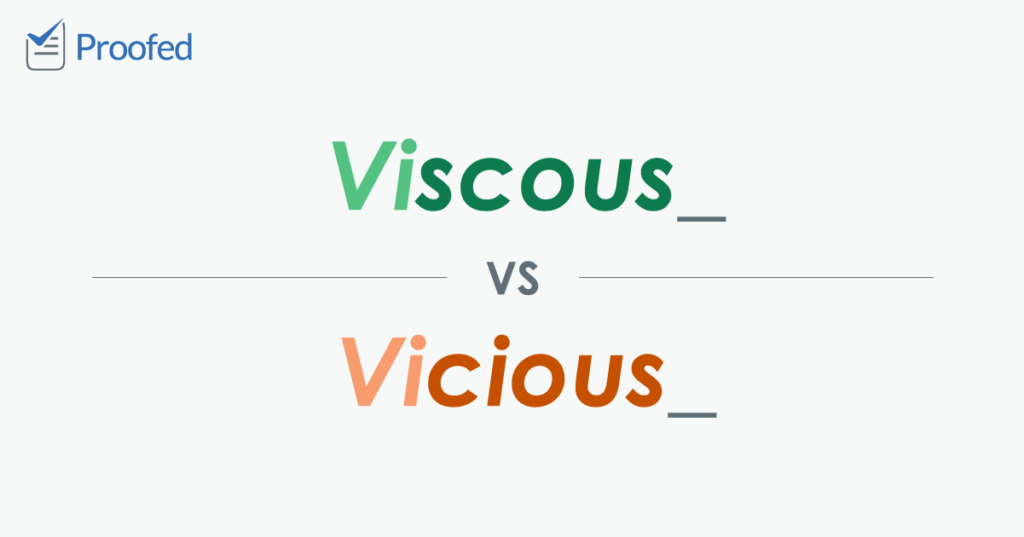
The clearest vicious vs viscous distinction is simple: vicious concerns harmful behavior or effects, whereas viscous concerns physical flow. Both words are adjectives, but they describe entirely different qualities.
| Feature | Vicious | Viscous |
| Main meaning | Cruel, violent, aggressive, harmful | Thick, sticky, slow-flowing |
| Describes | People, animals, actions, remarks, situations | Liquids, fluids, materials |
| Related noun | Viciousness | Viscosity |
| Common example | Vicious attack | Viscous fluid |
| Main idea | Harm or hostility | Resistance to flow |
Vicious vs Viscous Pronunciation
In U.S. English, vicious is pronounced /ˈvɪʃ·əs/, while viscous is pronounced /ˈvɪs·kəs/. Their similar spelling and opening sound can make them confusing when you hear them quickly.
Vicious vs Viscous Spelling
The spelling difference becomes easier when you focus on the middle letters. Vicious contains “ci,” while viscous contains “sc.” More importantly, remember the meaning: harmful behavior is vicious, while thick fluid is viscous.
Why Do People Confuse Vicious and Viscous?
People often confuse these words because they look nearly identical and both function as adjectives. Their pronunciation is also similar. However, their meanings belong to separate categories, which makes context the best clue when choosing between them.
Is Vicious the Same as Viscous?
No. They are not interchangeable. A dog can be vicious because it behaves aggressively. Honey can be viscous because it flows slowly. Saying that honey is vicious changes the meaning completely and produces an incorrect word choice.
An Easy Memory Trick
Remember this simple connection: vicious = violence and viscous = viscosity. If the sentence involves cruelty, aggression, danger, or harmful behavior, think vicious. If it involves thickness, stickiness, or slow fluid movement, think viscous.
Vicious can hurt; viscous can flow slowly.
Vicious vs Viscous in Real-Life Contexts
The vicious vs viscous difference becomes obvious when you see both words in ordinary situations. News reports may describe a vicious attack or rumor. A cookbook may mention viscous syrup. Scientists, meanwhile, may discuss a viscous fluid or measure its viscosity.
| Situation | Correct Word | Example |
| Dangerous animal | Vicious | A vicious dog |
| Violent attack | Vicious | A vicious attack |
| Harmful rumor | Vicious | A vicious rumor |
| Repeating problem | Vicious | A vicious cycle |
| Thick honey | Viscous | Viscous honey |
| Thick oil | Viscous | Viscous oil |
| Scientific fluid | Viscous | A viscous fluid |
| Thick mixture | Viscous | A viscous mixture |
Vicious in Literature and Media
Writers use vicious to create a strong sense of hostility, cruelty, or danger. A villain may deliver a vicious threat, while a character may face a vicious attack. The word adds emotional intensity and immediately signals serious harm or aggression.
Viscous in Science and Technical Writing
Scientists use viscous when discussing fluid behavior and material properties. A viscous fluid resists flowing easily. In technical writing, the related noun viscosity provides a more precise way to discuss that resistance and compare different fluids.
Viscous in Cooking and Everyday Descriptions
You can also encounter viscous outside technical writing. Honey, syrup, molasses, thick sauces, and some oils can be described as viscous. The word becomes useful when ordinary terms such as “thick” do not provide enough detail.
How to Use Vicious and Viscous in Sentences
Choosing the right word becomes easy when you identify what the adjective modifies. Use vicious for behavior, actions, people, animals, attacks, remarks, and harmful situations. Use viscous for liquids, fluids, and materials whose thickness affects how they move.
Vicious in a Sentence
“The vicious animal frightened everyone nearby.” Here, vicious describes dangerous behavior. You could also write, “The company faced a vicious backlash.” In both examples, the word expresses hostility, aggression, or harmful intensity.
Viscous in a Sentence
“The viscous liquid moved slowly through the pipe.” Here, viscous describes how the liquid behaves. You could also write, “The chef prepared a thick, viscous sauce.” Both examples focus on physical consistency and flow.

Vicious vs Viscous Sentence Comparison
| Incorrect or Correct | Better Sentence | Reason |
| The honey was vicious. | The honey was viscous. | Honey can be thick. |
| The dog was viscous. | The dog was vicious. | The dog can behave aggressively. |
| The attack was viscous. | The attack was vicious. | An attack can be violent. |
| The oil was vicious. | The oil was viscous. | Oil can have high viscosity. |
| It was a viscous remark. | It was a vicious remark. | A remark can be cruel or hurtful. |
Common Mistakes to Avoid
The biggest mistake is swapping these adjectives simply because they look similar. Before choosing a word, identify the subject. If you are describing harmful behavior, use vicious. If you are describing a thick substance and its flow, use viscous.
If you are working through other commonly confused English terms, you can also read Requester vs. Requestor for another useful spelling and usage comparison.
Confusing Vicious With Viscous
“Vicious liquid” is normally incorrect when you mean thick or slow-moving. Likewise, “viscous attack” is incorrect when you mean violent or cruel. Checking the noun immediately before the adjective can prevent both mistakes.
Using Viscous for People or Behavior
Viscous does not normally describe someone’s personality, attitude, or actions. If someone behaves cruelly or aggressively, vicious is the appropriate adjective. For example, “The vicious attacker frightened the crowd” uses the word correctly.
Using Vicious for Liquids
Honey, syrup, oil, and thick sauces are not vicious simply because they move slowly. When their thickness or resistance to flow matters, viscous is the correct word. This distinction is especially important in scientific and technical writing.
For another useful comparison involving standard English usage, see Incomplete vs. Uncomplete.
Vicious vs Viscous: Synonyms and Related Words
The synonyms also reveal the difference between these two adjectives. Vicious connects with aggression, cruelty, violence, and hostility. Viscous connects with thickness, stickiness, and slow movement. Their related nouns reinforce the same distinction.
| Word | Related Terms |
| Vicious | Aggressive, cruel, violent, hostile, brutal |
| Viscous | Thick, sticky, gluey, slow-flowing |
| Viciousness | Cruelty, aggression, violence |
| Viscosity | Thickness and resistance to flow |
Synonyms for Vicious
Useful synonyms include aggressive, cruel, violent, hostile, brutal, dangerous, malicious, and harmful. The exact choice depends on context because these words do not always carry identical shades of meaning.
Synonyms for Viscous
Common alternatives include thick, sticky, gluey, and slow-moving. However, these are not always perfect scientific substitutes. Viscosity remains the precise technical term for resistance to fluid flow.
Related Words You Should Know
Two especially useful nouns are viciousness and viscosity. Viciousness refers to the quality of being vicious. Viscosity refers to the quality of being viscous. Remembering these nouns makes the adjective distinction easier.
Vicious vs Viscous: Which One Should You Use?
Use vicious when the sentence involves cruelty, aggression, violence, harmful actions, hostile remarks, or a damaging cycle. Use viscous when the sentence concerns a thick liquid, fluid, material, or measurable resistance to flow.
| Meaning You Want | Correct Word |
| Dangerous animal | Vicious |
| Harmful action | Vicious |
| Violent attack | Vicious |
| Cruel remark | Vicious |
| Harmful cycle | Vicious |
| Thick honey | Viscous |
| Thick syrup | Viscous |
| Oil resistance | Viscous |
| Slow-flowing fluid | Viscous |
| Material viscosity | Viscous |
Vicious or Viscous? A Final Decision Test
Ask yourself one question: Am I describing harmful behavior or physical flow? If the answer is harmful behavior, choose vicious. If the answer is physical thickness or resistance to flow, choose viscous. This quick test works in everyday, academic, and professional writing.
Final Examples to Test Yourself
| Sentence | Correct Answer |
| The dog became ___ after being threatened. | Vicious |
| The honey was extremely ___. | Viscous |
| The reporter received a ___ response. | Vicious |
| The scientist tested the ___ fluid. | Viscous |
| They entered a ___ argument. | Vicious |
| The sauce became more ___ as it cooled. | Viscous |
For another spelling-focused comparison, read Shiny vs. Shiney. It offers another example of how similar-looking spellings can create confusion.
The vicious vs viscous difference is easy once you connect each word with its core idea. Vicious describes cruelty, aggression, violence, or harmful effects. Viscous describes thick substances that resist flowing easily.
Remember vicious = violence and viscous = viscosity, and you will have a simple way to choose the correct word whenever these two spellings cause confusion.