
When you are unsure about People Do vs People Does, the answer usually depends on one simple grammar rule: subject-verb agreement. In standard American English, people normally refers to more than one person, so it takes the plural verb do. That makes “people do” correct in sentences such as “People do make mistakes.” By contrast, “people does” is incorrect when people has its ordinary plural meaning. The confusion often comes from the fact that does is used with singular subjects such as he, she, it, or a person. Once you connect people with they, the correct form becomes much easier to remember.
People Do vs People Does: Which Is Correct?
The correct form is people do when people means multiple human beings. For example, “People do different things for fun” uses the plural subject people with the plural present-tense form do. Cambridge Dictionary identifies people as a plural noun in its ordinary meaning, while Oxford describes it as the usual plural form of person.
“People does” is not the standard form when people refers to individuals in general. The key is not the number of words in the sentence. Instead, identify the subject and decide whether it is singular or plural.
People Do Is the Correct Form
Use people do when you are talking about two or more people. The same agreement appears with they: “They do,” not “They does.”
For example, “People do care about their communities” is correct. “People does care about their communities” is incorrect in ordinary English.
Why “People Does” Sounds Wrong
The form does belongs to the present simple third-person singular. Cambridge explains that do has the present-tense forms do and does, with does used for third-person singular subjects.
That means does naturally follows subjects such as he, she, it, someone, everyone, and a person. Since ordinary people is plural, it normally takes do instead.
Quick Comparison Table
| Subject | Correct form | Example |
| People | do | People do make mistakes. |
| They | do | They do their best. |
| We | do | We do our work. |
| A person | does | A person does what they can. |
| He | does | He does his homework. |
| She | does | She does well at school. |
| Everyone | does | Everyone does something differently. |
| Someone | does | Someone does know the answer. |
Why “People Do” Is Grammatically Correct
The basic rule becomes easy once you understand what people represents. In ordinary English, people is a plural noun meaning multiple human beings. Therefore, it follows the same agreement pattern as they, students, workers, or children.
This explains why sentences such as “People do their best” and “People do different things” sound natural. The subject is plural, so the present-tense verb agrees with that plural subject.
People Is Normally a Plural Noun
People is the normal plural of person. Cambridge lists people as the plural form of person, while Oxford notes that persons is more formal and is used in particular contexts.
So you can think of the relationship this way: one person does something, while several people do something.
Plural Subjects Take “Do”
In the present simple, plural subjects normally use the base form of the verb. Cambridge’s present-simple pattern shows I, you, we, and they using the base form, while third-person singular subjects use the -s form.
For do, that distinction becomes do versus does. Therefore, “People do volunteer work” follows the same grammatical pattern as “They do volunteer work.”
The Simple “They” Test
When you are uncertain, replace people with they. If the replacement sounds right with do, your original sentence probably needs do too.
For example, “People do understand the problem” becomes “They do understand the problem.” Because they do is correct, people do is also correct.
Understanding Subject-Verb Agreement With Do and Does
Subject-verb agreement means that the verb form should match the grammatical number and person of its subject. With do in the present simple, the most useful distinction is plural subjects versus third-person singular subjects.
The rule becomes especially important in questions and negative sentences. There, do or does may act as an auxiliary verb rather than the main verb. Cambridge identifies do as one of English’s auxiliary verbs and explains its role in questions, negatives, and emphasis.
What Is Subject-Verb Agreement?
Subject-verb agreement connects the subject with the appropriate verb form. A plural subject generally takes the plural form, while a third-person singular subject takes the corresponding singular form in the present simple.
Compare “People do their jobs” with “A person does their job.” The meaning is similar, but the subjects have different grammatical numbers.
When Do We Use “Do”?
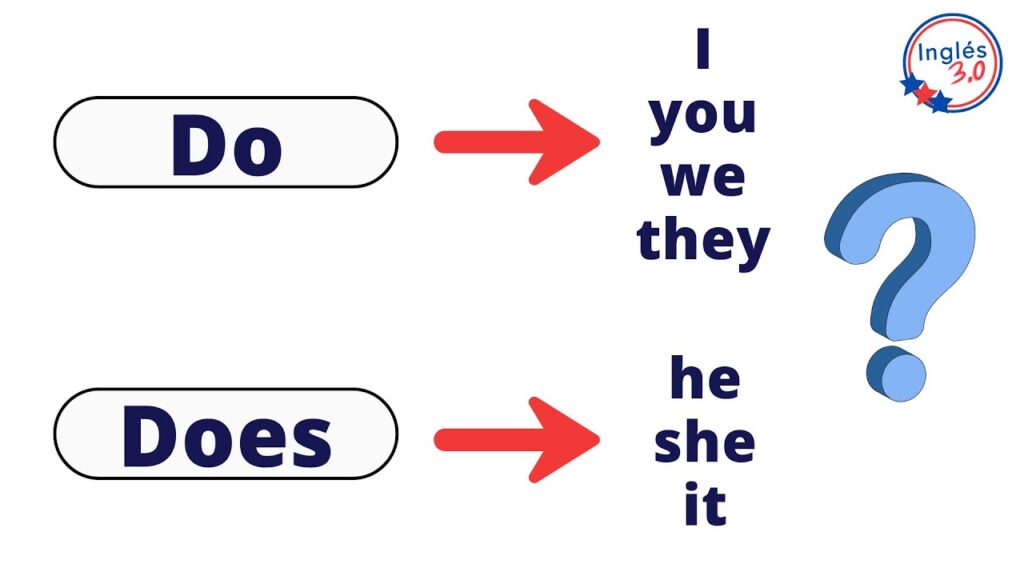
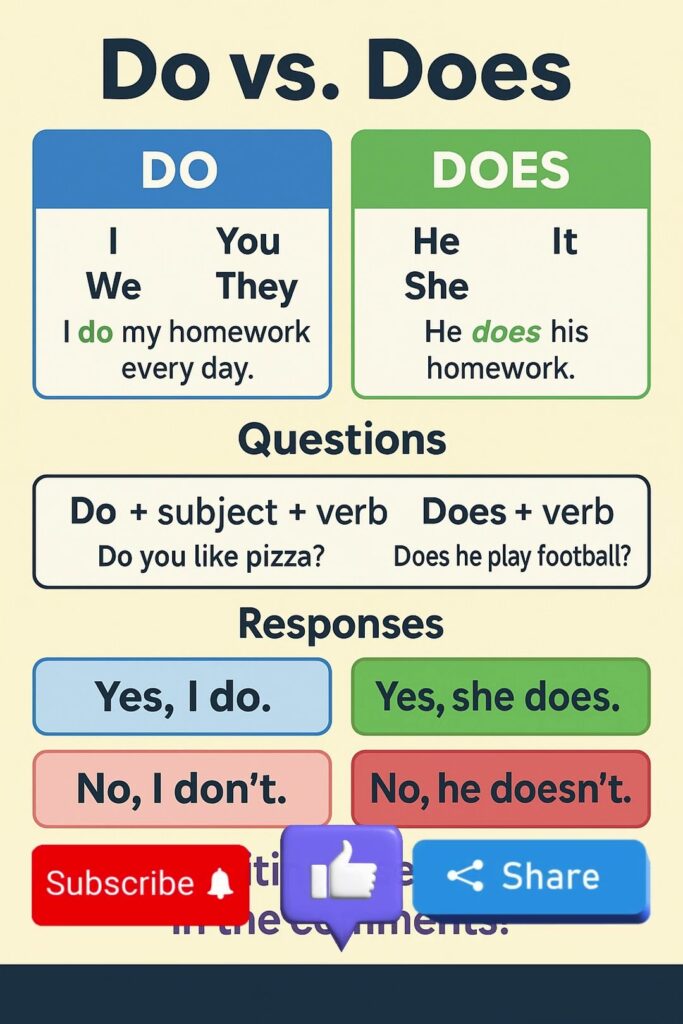
Use do with I, you, we, and they, as well as plural nouns such as people, students, and workers.
Examples include “People do what they can,” “They do enough research,” and “We do our homework.” In each case, the subject does not require the third-person singular form does.
When Do We Use “Does”?
Use does with third-person singular subjects in the present simple. Common examples include he, she, it, someone, everyone, and singular nouns.
For example, “Everyone does their part” is correct. So is “A person does what they believe is right.”
Why Third-Person Singular Uses “Does”
The form does is the third-person singular present form of do. Cambridge lists the three main forms of the verb as do, did, and done, while identifying does as its third-person singular present form.
This is why “She does her work” is correct, while “She do her work” is not. The subject she requires the singular form.
Do/Does + Base Verb
When do or does works as an auxiliary verb, the main verb stays in its base form. This point causes many learners to make a second mistake.
Correct: “People do like this idea.”
Incorrect: “People do likes this idea.”
Correct: “Does a person like this idea?”
Incorrect: “Does a person likes this idea?”
Cambridge specifically describes question, negative, and emphatic structures using do/does + base form.
How to Use “People Do” in Sentences
The phrase people do appears in everyday conversation, professional writing, questions, negative statements, and emphatic sentences. Its exact function depends on what follows it.
In practice, you will most often see people do either as a normal verb phrase or as an auxiliary structure. Understanding both uses prevents you from treating every instance of do in the same way.
“People Do” in Affirmative Sentences
When do is the main verb, it can describe an action, task, or activity. For example, “People do different things on weekends” uses do as the main verb.
You can also use do as an auxiliary for emphasis: “People do care about this issue.” Here, do adds emphasis to the main verb care. Cambridge confirms that auxiliary do can create emphatic statements.
“Do People” in Questions
Use do people + base verb when forming most present-simple questions involving people.
Examples include “Do people understand this rule?” and “Do people need more information?” The auxiliary do comes before the subject, while the main verb remains in its base form.
“People Don’t” in Negative Sentences
The negative form is people do not or the more conversational people don’t.
For example, “People don’t always agree” is correct. “People doesn’t always agree” is incorrect because people remains a plural subject.
“People Do” for Emphasis
You can use do to add emphasis to an affirmative statement. “People do make mistakes” is stronger than the neutral “People make mistakes.”
This construction can be useful when correcting someone or stressing that a statement is true. The important point is that the main verb remains in its base form after auxiliary do.
People vs Person: Do or Does?
The easiest way to understand the difference is to compare people with person. Person refers to one individual, while people normally refers to more than one.
Cambridge and Oxford both identify people as the ordinary plural of person. Therefore, the basic pattern is a person does but people do.
When to Use “People”
Use people when you mean multiple individuals or human beings generally. For example, “People do strange things sometimes” refers to human beings in general.
Oxford also lists people as a plural noun for humans generally, which explains why it commonly pairs with plural verbs.
When to Use “Person”
Use person when referring to one individual. Because person is singular, it normally takes a third-person singular verb.
For example, “A person does not need to agree with everyone” is grammatically correct. The subject is a person, not people.
People vs Persons vs Peoples
People is the normal plural form of person in everyday English. Persons still appears in formal or specialized contexts, while peoples can refer to distinct nations, ethnic groups, or cultural groups.
These forms should not be treated as interchangeable. The meaning and context determine which noun you need.
People and Person in Side-by-Side Examples
| Singular | Plural |
| A person does the job. | People do the job. |
| One person does not agree. | Several people do not agree. |
| Does a person need help? | Do people need help? |
| A person does their best. | People do their best. |
This comparison makes the plural subject pattern much easier to recognize.
Common Mistakes With “People Do” and “People Does”
Most mistakes happen because writers focus on the verb instead of the subject. If you identify the subject first, the correct form usually becomes obvious.
Another common problem involves auxiliary verbs. Once do or does appears before another verb, the following verb should normally remain in its base form.
Mistake #1: Using “People Does”
Incorrect: “People does their work every day.”
Correct: “People do their work every day.”
The problem is subject-verb agreement. People is plural in this ordinary meaning, so it takes do.
Mistake #2: Using “People Doesn’t”
Incorrect: “People doesn’t always agree.”
Correct: “People don’t always agree.”
The negative form follows the same agreement rule. Use do not/don’t with plural people and does not/doesn’t with a third-person singular subject.
Mistake #3: Asking “Does People…?”
Incorrect: “Does people understand the rule?”
Correct: “Do people understand the rule?”
The auxiliary must agree with the subject. Because people is plural, the question begins with do.
Mistake #4: Adding “-s” After Do or Does
Incorrect: “Do people likes coffee?”
Correct: “Do people like coffee?”
After auxiliary do or does, use the base verb. The auxiliary carries the present-tense agreement, so the main verb does not take an additional -s.
Mistake #5: Confusing People With Everyone
People and everyone do not behave the same way grammatically. People is plural, but everyone is grammatically singular.
Therefore, “People do their best” is correct, while “Everyone does their best” is also correct. The difference comes from the grammatical number of the subject.
Mistake #6: Letting a Nearby Noun Control the Verb
Do not choose the verb based on the noun closest to it. Find the actual subject first.
For example, “People in my neighborhood do volunteer work” is correct. Neighborhood is singular, but it is not the subject. People controls the verb.
Do People or Does People? Using the Correct Form in Questions
When the subject is people, the correct present-simple question pattern is do people + base verb. This applies whether you are asking about opinions, habits, needs, preferences, or actions.
Cambridge’s present-simple guidance shows do with I, you, we, and they, and does with third-person singular subjects.
Correct Question Structure: “Do People + Base Verb”
Use this structure for ordinary present-simple questions:
Do people + base verb + …?
Examples:
“Do people understand the difference?”
“Do people usually work on Fridays?”
“Do people enjoy this type of music?”
“Do people need a permit?”
Why “Does People” Is Incorrect
“Does people” fails because people is plural in its ordinary meaning. The singular form would require a singular subject such as a person.
Compare these two questions: “Do people agree?” and “Does a person agree?” Both are grammatical because the auxiliary matches the subject.
Compare “Do People” With “Does a Person”
This is one of the simplest comparisons to remember.
Do people understand?
Does a person understand?
The first subject is plural. The second subject is singular. That difference determines whether you use do or does.
Common Question Patterns
| Incorrect | Correct |
| Does people agree? | Do people agree? |
| Does people know? | Do people know? |
| Does people need help? | Do people need help? |
| Do a person agree? | Does a person agree? |
| Does a person needs help? | Does a person need help? |
The second set also demonstrates why the main verb stays in its base form after does.
When “People” Can Seem Singular
There is one important nuance worth knowing. People does not always have exactly the same meaning. In addition to its ordinary plural meaning, dictionaries document a noun sense referring to the members of a particular nation, culture, or group. Cambridge, for example, lists a countable noun sense for people connected with a particular country or shared culture.
However, this specialized meaning does not change the basic answer for ordinary sentences about human beings. If you mean several individuals, use people do.
People Is Plural in Its Ordinary Meaning
When people means men, women, and children generally, it is plural.
“People do what they think is best.”
“People are different.”
“People have different opinions.”
These examples follow the ordinary plural pattern documented by Cambridge and Oxford.
Why “People” Sometimes Refers to a Group
In expressions such as “the American people,” people can refer collectively to the members of a nation. Oxford also documents uses referring to people who belong to a particular country, ethnic group, or other community.
That meaning can look collective, but you should not automatically treat people like a singular collective noun such as committee. Context determines the grammatical structure.
“Everyone” Is Different From “People”
Everyone refers to every individual in a group but is grammatically singular. That is why we say “Everyone does their best,” not “Everyone do their best.”
By contrast, people is normally plural. So the matching forms are people do and everyone does.
Do Not Let the Exception Confuse the Main Rule
For everyday American English, remember the simple rule first: people do.
The specialized noun uses of people and peoples matter when you discuss nations, cultures, or distinct communities. They should not make ordinary sentences such as “People do make mistakes” seem uncertain.
People Do in Different Tenses and Grammar Structures
The do/does question mainly concerns the present simple. Once you move into other tenses, the verb form changes according to the tense rather than simply switching between do and does.
Knowing these forms helps you avoid applying the present-tense rule everywhere.
Present Simple
Use people do for ordinary present-simple statements.
“People do their work every day.”
“People do not always agree.”
“Do people understand the instructions?”
The same subject remains plural in all three structures.
Past Simple
Use people did in the simple past.
“People did what they could.”
“People did not know the answer.”
“Did people understand the instructions?”
The past form did works with both singular and plural subjects in these structures.
Present Continuous
Use people are doing for an action happening around the present time.
“People are doing more research.”
Here, are agrees with plural people, while doing expresses the continuous action.
Present Perfect
Use people have done in the present perfect.
“People have done enough research.”
The auxiliary have agrees with plural people. The past participle done remains unchanged.
Future
Use people will do for future actions.
“People will do what they think is necessary.”
The modal will does not change according to whether the subject is singular or plural.
Quick Tense Comparison
| Tense | Correct example |
| Present simple | People do their work. |
| Past simple | People did their work. |
| Present continuous | People are doing their work. |
| Present perfect | People have done their work. |
| Future | People will do their work. |
This table shows why people does is not the general form of the verb. The correct form depends on the tense and structure.
People Do vs People Does: Real-World Examples and Quick Test
The best way to remember the rule is to see it in natural situations. You are likely to encounter people do in conversations, workplace writing, school assignments, articles, and online discussions.
The same principle works everywhere because standard subject-verb agreement does not disappear in informal English.
Everyday Conversation
“People do things differently.”
“People do get tired.”
“Do people really believe that?”
“People don’t always agree.”
These sentences sound natural because people behaves as a plural subject.
Professional and Workplace Writing
In workplace writing, you might see sentences such as “People do respond well to clear instructions” or “People don’t always understand complicated policies.”
For formal writing, focus on clarity rather than trying to make the sentence sound more complicated. Correct agreement is usually the simplest choice.
Academic Writing
Academic writing frequently uses people to describe groups of individuals.
For example, “People do not always respond to risk in the same way” is grammatically sound. You can then replace people with a more specific noun when the research requires greater precision.
Social Media and Informal English
Informal posts often shorten do not to don’t. That does not change the agreement rule.
“People don’t care” is correct. “People doesn’t care” is not standard grammar, even in casual writing.
The “They” Test
Replace people with they. If the sentence becomes “they do,” you can usually keep do with people.
“People do understand” → “They do understand.”
This quick substitution is especially useful when you are editing your own writing.
The Three-Second Test
Ask yourself one question: Is the subject one person or more than one?
If it is people, choose do. If it is a person, someone, or everyone, choose does in the present simple.
That simple check prevents most errors involving people do vs people does.
Mini Quiz: People Do or People Does?
Test the rule without looking back at the explanations. Choose do or does for each sentence.
Choose “Do” or “Does”
- People ___ their best when they feel supported.
- ___ people understand this rule?
- Everyone ___ things differently.
- A person ___ not need permission in this situation.
- People ___ not always agree.
- ___ people usually arrive early?
- Someone ___ know the answer.
- People ___ different kinds of work.
- Does a person ___ need an appointment?
- People ___ make mistakes.
Answers and Explanations
- do — People is plural.
- Do — use do to form a question with plural people.
- does — everyone is grammatically singular.
- does — a person is singular.
- do — plural people takes do not/don’t.
- Do — plural people takes do in present-simple questions.
- does — someone is grammatically singular.
- do — people is plural.
- need — after does, use the base verb need.
- do — plural people takes do.
What the Quiz Reveals
The central issue is not the word people itself. It is the relationship between the subject and verb.
Once you identify whether the subject is plural or third-person singular, the correct form usually becomes automatic.
Final Verdict: People Do or People Does?
For ordinary American English, people do is the correct form when people refers to multiple individuals or human beings generally. People does is incorrect in that ordinary plural use.
The easiest memory trick is to connect people with they. If you would say “they do,” you should normally say “people do.”
The Rule to Remember
People → they → do
A person → he/she/they → does
Everyone → does
Someone → does
This simple pattern covers most everyday situations.
Correct Forms at a Glance
| Expression | Correct? |
| People do | ✓ |
| People does | ✗ |
| People don’t | ✓ |
| People doesn’t | ✗ |
| Do people…? | ✓ |
| Does people…? | ✗ |
| A person does | ✓ |
| Does a person…? | ✓ |
| Everyone does | ✓ |
| They do | ✓ |
Final Takeaway
When people means multiple people, use do, not does. Use does with a third-person singular subject such as a person, someone, or everyone.
The biggest practical lesson is simple: identify the subject before choosing the verb. Once you do that, the People Do vs People Does question becomes straightforward.
Frequently Asked Questions
Is “people do” grammatically correct?
Yes. “People do” is correct when people has its ordinary plural meaning.
Is “people does” ever correct?
Not in ordinary sentences where people means multiple individuals. Specialized meanings of people require attention to context.
Do people or does people?
Use do people in present-simple questions. For example, “Do people understand the rule?”
Is people singular or plural?
People is normally plural when it means multiple human beings. Cambridge and Oxford both identify this ordinary use as plural.
Why do people take “do”?
Because ordinary people is a plural subject. Plural subjects use do rather than the third-person singular does.
Is “people doesn’t” correct?
No. Use people don’t or people do not in standard English.
Do you say “a person do” or “a person does”?
Use a person does because a person is singular.
Why is “everyone does” correct but “people does” wrong?
Everyone is grammatically singular, while ordinary people is plural. Therefore, everyone does but people do.
Do people like or do people likes?
Use do people like. After auxiliary do, the main verb stays in its base form.
Does a person need or does a person needs?
Use does a person need. After does, use the base verb need.
What is the easiest way to remember do vs. does?
Think they do and he/she/it does. Since people normally works like they, use people do.
Conclusion
The answer is clear: people do is the standard form when people refers to multiple individuals. The word people is normally plural, so it takes do, are, and have in the appropriate present-tense structures.
By contrast, does belongs with third-person singular subjects such as a person, someone, and everyone. When you are unsure, replace people with they. If the sentence becomes “they do,” you have your answer.
Once you understand that subject-verb agreement pattern, you can confidently handle questions, negatives, emphasis, and everyday sentences without second-guessing the verb.