
When you compare two things, should you say simpler or more simple? If you have ever hesitated over this choice, you are not alone. Both forms appear in English, but they do not have the same level of everyday use. Simpler is generally the more natural and preferred comparative form. However, more simple is also grammatically possible in English. The choice becomes clearer once you understand how comparative adjectives work. In particular, simple is a two-syllable adjective that can take either comparative pattern. This guide explains the grammar, meaning, usage, common mistakes, and practical differences so you can choose the form that sounds right in American English.
Quick Answer: Simpler or More Simple?
Simpler is generally the preferred and more natural comparative form of simple. However, more simple is also an acceptable comparative construction, so it is not automatically wrong. Oxford’s American English dictionary lists simpler as the comparative and notes that speakers can also use more simple.
For most everyday, professional, and academic writing, simpler is the safest default. For example, “This method is simpler than the old one” sounds natural and clear.
Why Do We Say “Simpler” Instead of “More Simple”?
English forms comparative adjectives in several ways. Many short adjectives take -er, while longer adjectives commonly use more. However, this is not an absolute rule. Some two-syllable adjectives can use either pattern. The British Council specifically includes simple among those adjectives.
How Comparative Adjectives Work in English
Consider these common patterns:
| Base adjective | Comparative | Pattern |
| small | smaller | -er |
| fast | faster | -er |
| happy | happier | -er |
| careful | more careful | more + adjective |
| beautiful | more beautiful | more + adjective |
| simple | simpler / more simple | either pattern |
This shows why the basic “short words take -er, long words take more” rule needs some qualification. English has established exceptions and flexible patterns. The important point is that simple belongs to the group that permits both forms.
Where “Simple” Fits in the Comparative Rule
Simple has two syllables, not one. The British Council identifies it as a two-syllable adjective that can form its comparative with either -er/-r or more. It gives both simpler and more simple as examples.
Oxford’s American dictionary follows the same general picture. It gives simpler as the comparative and simplest as the superlative, while also noting that more simple and most simple can be used.
Why “Simpler” Became the Preferred Form
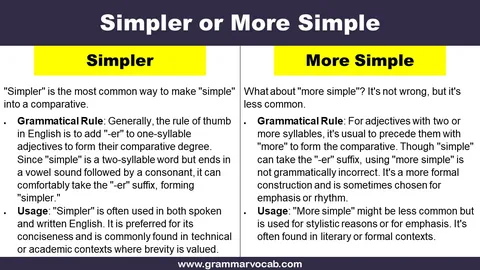
The main reason to choose simpler is conventional usage and naturalness, not a rigid rule that makes more simple incorrect. English speakers commonly use simpler in phrases such as “a simpler solution,” “a simpler explanation,” and “a simpler method.”
In practice, simpler works smoothly in both conversation and formal writing. That makes it the best default when you do not have a specific reason to choose the alternative.
What Does “Simpler” Mean?
Simpler is the comparative form of simple. It describes something that is less complicated, easier to understand, easier to do, or more straightforward than something else. Cambridge defines simple in its “easy” sense as something that is easy to understand or do and not difficult.
For example, “This explanation is simpler than the first one” means the second explanation has less complexity or is easier to understand. The comparison may also be implied, as in “We need a simpler solution.”
Simpler Definition and Meaning
The exact meaning depends on context. A simpler method may require fewer steps. A simpler explanation may use clearer language. A simpler design may contain fewer unnecessary elements.
So, simpler does not always mean physically smaller or shorter. It usually means that something has less complexity than another option.
How to Use “Simpler” in a Sentence
You can use simpler before a noun or after a linking verb:
- We need a simpler approach to the problem.
- Her explanation was simpler than mine.
- The new process is simpler to follow.
- This design offers a simpler solution.
- Can you give me a simpler answer?
You can also use simpler with than when you identify the thing being compared: “This process is simpler than the previous one.”
Simpler vs. Simple
Simple describes something without making a comparative judgment. Simpler compares one thing with another.
For example, “The instructions are simple” gives a general description. “These instructions are simpler than the old ones” makes a comparison.
The difference is small in form but important in meaning. The -er ending signals the comparative relationship.
Is “More Simple” Wrong?
No. More simple is not automatically wrong. Both the British Council and Oxford recognize it as a possible comparative construction. The British Council specifically gives simple → simpler and more simple as alternative forms.
The better distinction is preferred versus less common, rather than correct versus incorrect. If you write “This version is more simple,” readers can understand the sentence, and the construction can be grammatically acceptable.
Is “More Simple” Grammatically Correct?
Yes, more simple can be grammatically correct. Oxford’s American English dictionary explicitly states that users can also say more simple and most simple.
However, that does not mean the two forms are equally common in every situation. Simpler is usually the more straightforward choice when you simply want to compare two things.
When Can You Use “More Simple”?
You can use more simple when that construction fits your sentence naturally. Context, rhythm, emphasis, or personal style can influence the choice.
For example:
The second explanation is more simple than the first.
This sentence is grammatically possible. Still, many readers would find:
The second explanation is simpler than the first.
more natural.
The important point is that more simple does not need a special grammatical justification every time you use it. It is an accepted alternative, although it is generally less common than simpler. The British Council even uses more simple in an ordinary example rather than restricting it to special emphasis or contrast.
Simpler vs. More Simple: What’s the Difference?
The two forms express essentially the same comparative idea. Both can describe something that has less complexity than another thing.
The main difference is form and conventional usage. Simpler is a single-word comparative adjective, while more simple uses more + adjective. Oxford lists simpler as the standard comparative entry but also recognizes more simple.
Meaning and Grammar
Compare these sentences:
This explanation is simpler.
This explanation is more simple.
Both compare the explanation with something understood from context. Neither sentence changes the basic meaning simply because the writer selected a different comparative construction.
However, simpler tends to sound more natural as the default choice.
Naturalness and Usage
If you are writing an email, article, report, or set of instructions, simpler will usually be the easiest choice.
For example:
We need a simpler process.
This sounds direct and natural. You could write:
We need a more simple process.
The second version is possible, but many readers would prefer the first. The distinction is therefore about conventional preference rather than a strict grammatical ban.
Quick Comparison Table
| Feature | Simpler | More Simple |
| Grammar | Comparative adjective | Comparative adjective phrase |
| Basic meaning | Less complicated | Less complicated |
| Commonness | More common | Less common |
| Everyday use | Very natural | Acceptable |
| Formal writing | Fully appropriate | Possible |
| Example | This method is simpler. | This method is more simple. |
Simpler vs. More Simply: What’s the Difference?
This is a different issue because simpler and more simply belong to different grammatical categories. Simpler is a comparative adjective, while more simply is a comparative adverbial expression.
“Simpler” Is a Comparative Adjective
An adjective can describe a noun or follow a linking verb. For example:
We need a simpler explanation.
Here, simpler describes the noun explanation. In “The new process is simpler,” it describes the subject process.
“More Simply” Is a Comparative Adverb
An adverb describes how an action happens. For example:
Please explain the process more simply.
Here, more simply describes the verb explain. It tells us how the explanation should be given.
Examples of Simpler vs. More Simply
Compare these sentences:
| Expression | Correct use | Why |
| a simpler explanation | Yes | Simpler describes explanation. |
| explain it more simply | Yes | More simply describes explain. |
| a more simply explanation | No | The noun needs an adjective. |
| explain it simpler | Usually nonstandard in careful writing | An adverbial form is needed. |
So remember the basic distinction: simpler describes a thing; more simply describes an action or manner.
Simpler or More Simple in Real-World Writing
You will encounter simpler across many kinds of English. It works naturally in conversation, workplace communication, academic writing, technical documentation, and general online content. Cambridge’s corpus examples also include real-world uses of simpler in contexts involving explanations, analyses, designs, and systems.
Simpler in Everyday English
In everyday conversation, simpler is often the natural choice:
Is there a simpler way to do this?
I need a simpler explanation.
Let’s use the simpler option.
These examples sound direct because simpler has become a familiar comparative form. You do not need to make the sentence more formal by replacing it with more simple.
Simpler in Academic and Professional Writing
Simpler is also appropriate in formal writing. Academic or professional language does not require you to use more simple.
For example:
The researchers used a simpler model.
This approach provides a simpler explanation of the results.
In technical writing, simpler can also improve clarity when you compare systems, processes, or methods. The goal should be precise communication, not unnecessarily complicated wording.
More Simple in Context
More simple can still appear in professional or academic contexts. It should not be treated as an error merely because simpler is more common.
For example:
The revised procedure is more simple in structure.
You might still prefer “simpler in structure,” but the original construction is understandable and can be grammatical. When editing for a broad American audience, however, simpler will usually be the cleaner default.
Examples of Simpler and More Simple in Sentences
Here are natural comparisons:
Simpler:
This recipe is simpler than the original.
The new interface is simpler to navigate.
Her explanation was simpler and clearer.
We need a simpler solution.
More simple:
The revised design is more simple in appearance.
The second explanation is more simple than the first.
This version uses a more simple structure.
Again, these examples do not establish a different dictionary meaning. The main difference is how natural and conventional each construction sounds in context.
Common Mistakes With Simpler and More Simple
Most mistakes come from treating the comparative rule as more rigid than it really is. Learners often memorize “short adjectives take -er and long adjectives take more,” then apply that rule without considering exceptions.
Mistake 1: Saying “More Simple” Is Always Wrong
This is the biggest misconception. More simple is an accepted comparative construction, even though simpler is usually preferred. Both Oxford and the British Council support this distinction.
Mistake 2: Using “More Simpler”
Avoid combining the two comparative markers in standard English:
❌ This method is more simpler.
Instead, choose one:
✓ This method is simpler.
✓ This method is more simple.
The problem is not that more and simple can never appear together. The problem is adding more to the already comparative simpler.
Mistake 3: Confusing “Simpler” With “More Simply”
These forms have different jobs:
We need a simpler method.
Please explain the method more simply.
The first uses a comparative adjective. The second uses a comparative adverbial form.
Mistake 4: Calling “Simple” a One-Syllable Adjective
Simple has two syllables. This matters because its comparative pattern is better understood through the behavior of two-syllable adjectives.
The British Council specifically lists simple among the two-syllable adjectives that can take either -er/-r or more.
Mistake 5: Assuming Formal Writing Requires “More Simple”
Formal writing does not require more simple. In fact, simpler works perfectly well in professional, academic, and technical contexts.
Choose the form that communicates your meaning naturally and clearly.
Practical Writing Guide: Which Form Should You Use?
If you are unsure which form to choose, start with simpler. It is the conventional comparative form listed by Oxford and the form you will commonly see in natural English.
Use “Simpler” When…
Choose simpler when you want the most natural default:
- This is a simpler solution.
- We need a simpler explanation.
- The new process is simpler.
- Can you make the instructions simpler?
- She found a simpler approach.
It is especially useful when you want your sentence to sound direct without drawing attention to the grammar itself.
Consider “More Simple” When…
Use more simple when it fits the wording or rhythm of your sentence. It can also occur when a writer naturally chooses the more + adjective construction.
For example:
The second model has a more simple structure.
You could easily replace it with “a simpler structure,” and many editors would prefer that version. Still, the existence of a preferred alternative does not make more simple inherently incorrect.
Better Alternatives to “Simpler”
Sometimes another adjective communicates your exact meaning better:
- easier — when something requires less effort
- clearer — when something is easier to understand
- less complicated — when complexity is the main issue
- more straightforward — when something is direct or uncomplicated
- less difficult — when difficulty is the main comparison
For example, “This explanation is clearer” may be more precise than “This explanation is simpler” if your main concern is understanding rather than complexity.
A Simple Rule to Remember
When you need the normal comparative form of simple, use simpler by default.
However, do not mark more simple as automatically wrong. Authoritative grammar and dictionary sources recognize both patterns.
FAQs
Is “simpler” grammatically correct?
Yes. Simpler is the standard comparative form commonly used with simple.
Is “more simple” grammatically correct?
Yes. More simple can be grammatically acceptable, although it is generally less common than simpler.
Is “simpler or more simple” better?
Simpler is usually the better default because it sounds more natural in most everyday and professional contexts.
Is “more simple” formal English?
It can occur in formal English, but you do not need it to make your writing sound formal. Simpler works well in formal writing too.
Why is “simpler” more common?
Simpler is an established comparative form and is widely used in natural English. Oxford lists it as the primary comparative while also recognizing more simple.
What is the comparative form of “simple”?
The usual comparative form is simpler. More simple is also possible according to Oxford and the British Council.
Is “more simpler” correct?
No. In standard English, avoid combining more with the already comparative simpler. Use simpler or more simple instead.
What is the difference between “simpler” and “more simply”?
Simpler is a comparative adjective, while more simply is a comparative adverbial expression. For example, “a simpler method” versus “explain it more simply.”
Can I use “simpler” in academic writing?
Yes. Simpler is appropriate for academic, professional, and technical writing when it accurately expresses the comparison.
Which form should I use in American English?
For most situations, choose simpler. It is natural, concise, and recognized as the standard comparative form in the Oxford Advanced American Dictionary.
Final Verdict: Simpler or More Simple?
So, simpler or more simple? In most situations, choose simpler. It is the more common and natural comparative form, and it works across casual, professional, academic, and technical writing.
However, more simple is not automatically wrong. Reliable grammar and dictionary sources recognize it as an alternative comparative construction. The important point is that English does not force a strict either-or rule here. Simple is a two-syllable adjective that can use either pattern.
Remember the practical rule: use “simpler” when you want the natural default, but recognize “more simple” as a possible alternative. Never use “more simpler” in standard English. Once you understand that distinction, this common grammar question becomes much easier to handle.