
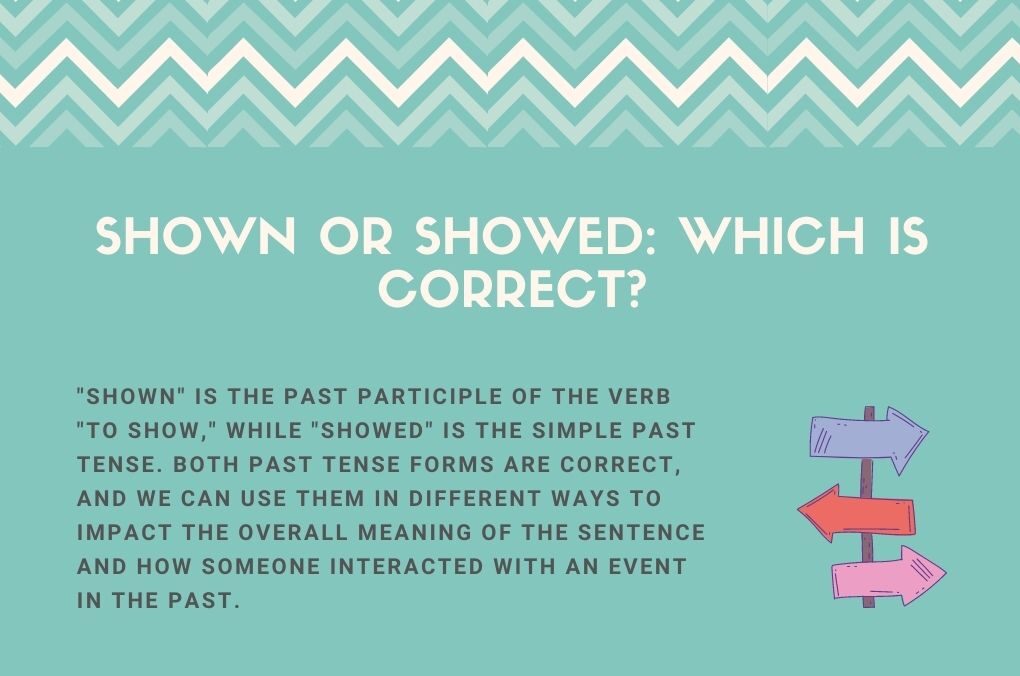
If you are unsure whether to write “showed” or “shown,” you are not alone. Both words come from the verb show, but they serve different grammatical roles. The basic pattern is simple: show → showed → shown. “Showed” is normally the simple past tense, while “shown” is the past participle. The difference becomes especially important when you use perfect tenses or passive voice. For example, you can write, “She showed me the report yesterday,” but “She has shown me the report before.” You would also write, “The report was shown to the committee.” Understanding the verb form behind each sentence makes the choice much easier.
Quick Answer: Showed vs. Shown
Showed is the simple past form of show, while shown is the standard past participle. Use “showed” for a completed past action and “shown” after forms of have or be in constructions such as “has shown” and “was shown.”
| Form | Grammatical role | Example |
| show | Base form | I show the results. |
| showed | Simple past | I showed the results yesterday. |
| shown | Past participle | I have shown the results before. |
| showing | Present participle | I am showing the results now. |
The important point is that shown does not simply mean “past tense.” It is a different verb form. You will commonly see it in perfect constructions such as “has shown” and passive constructions such as “was shown.”
Why Do People Confuse Showed and Shown?
People confuse these forms because both describe an action that happened or began in the past. They also come from the same irregular verb, so it is easy to treat them as interchangeable. In everyday speech, the difference can feel less obvious than it looks on paper.
Both Forms Come From the Same Verb
The verb show has several forms: show, showed, shown, and showing. Unlike regular verbs such as walk → walked → walked, its simple past and past participle are different. Cambridge identifies “showed” as the past tense and “shown” as the past participle in American English.
Past Tense and Past Participle Are Not the Same
A verb tense tells you when an action occurs, while a verb form helps build the grammatical structure. “Showed” can stand as the main past-tense verb: “The manager showed us the figures.” “Shown,” however, normally works as a past participle in structures such as “The manager has shown us the figures” or “The figures were shown to the team.”
Why “Have Showed” Sounds Tempting
It is tempting to say “have showed” because “showed” is clearly associated with the past. However, standard American English uses have shown, not “have showed,” when forming the present perfect. The pattern is have or has + past participle.
What Does “Showed” Mean?
Showed is the simple past form of show. You use it when you describe an action that happened in the past and present it as a completed event. It can describe revealing something, demonstrating something, expressing something, guiding someone, or making something visible.
Showed as the Simple Past
Use “showed” when the sentence has a straightforward past-time meaning.
For example:
Maria showed me her new apartment yesterday.
The teacher showed the class how the experiment worked.
The results showed a significant change.
He showed great patience during the meeting.
These sentences use “showed” as the main verb. You do not need has, have, or had before it.
When Should You Use “Showed”?
Choose “showed” when you are simply reporting what someone or something did in the past.
For example, if you say, “The chart showed a decline last year,” you are describing a completed past observation. Similarly, “She showed me the email” reports a completed action.
Time expressions can help, but they do not decide the answer by themselves. Words such as yesterday, last week, and in 2025 often appear with simple past verbs. However, the structure of the sentence matters more than the time word.
Examples of “Showed”
The presentation showed why the project needed more funding.
Jake showed me the correct address.
The test showed that the device was working.
She showed remarkable confidence during the interview.
The movie showed a different side of the character.
These examples demonstrate several meanings of show. Cambridge lists uses that include making something visible, expressing something, explaining something, proving something, and recording information.
What Does “Shown” Mean?
Shown is the standard past participle of show. It commonly appears with auxiliary verbs in perfect constructions and with forms of be in passive constructions. That is why you see phrases such as “has shown,” “had shown,” “was shown,” and “has been shown.”
Shown as a Past Participle
A past participle is a verb form used in several grammatical constructions. With show, that form is shown.
For example:
The research has shown promising results.
She had shown considerable improvement.
The evidence has shown that the approach can work.
Here, “shown” does not act as an ordinary simple past verb. The auxiliary verb helps create the tense or construction.
Shown in Perfect Tenses
The present perfect uses have or has + past participle. Therefore, the correct pattern is:
have/has + shown
Examples include:
Scientists have shown that the method works.
The company has shown steady growth.
She has shown excellent judgment.
The past perfect uses had + past participle:
The study had shown a similar pattern before the new data arrived.
The British Council describes the present perfect as have or has + past participle, typically connecting a past action or state with the present.
Shown in Passive Voice
This is an important distinction that many quick grammar guides overlook. Shown also appears in passive constructions with forms of be.
For example:
The documentary was shown last night.
The results were shown to the committee.
The new evidence has been shown to the public.
The process is shown in the diagram.
The passive voice uses a form of be plus a past participle. Therefore, “was shown” is correct even though “was” refers to the past.
Showed vs. Shown: Side-by-Side Comparison
The easiest way to understand the difference is to compare the grammatical patterns rather than memorizing isolated words.
| Feature | Showed | Shown |
| Basic form | Past tense | Past participle |
| Main use | Simple past | Perfect and passive constructions |
| Example | She showed the photo. | She has shown the photo. |
| With have/has | Usually incorrect in standard usage | Correct |
| With had | Usually incorrect in standard usage | Correct |
| With was/were | Not the standard passive form | Correct |
| Can stand as the simple past? | Yes | No |
| Standard American English | Yes | Yes |
In practice, ask yourself what grammatical job the word performs. If show is the main verb in a straightforward past-tense sentence, showed is usually the answer. If the sentence requires a past participle, use shown.
A One-Minute Grammar Test
Try replacing the word with another irregular verb. For example:
She showed me the report.
Compare:
She gave me the report.
Both use simple past forms.
Now consider:
She has shown me the report.
Compare:
She has given me the report.
Both use past participles after has. This pattern can help you recognize the difference quickly.
Show, Showed, Shown, and Showing
These four forms have different functions:
Show: I show the results every Friday.
Showed: I showed the results yesterday.
Shown: I have shown the results before.
Showing: I am showing the results now.
Learning all four forms together is more effective than memorizing “showed vs. shown” as an isolated rule.
When Should You Use “Showed” or “Shown”?
Use showed when you need the simple past form. Use shown when the sentence requires the past participle. The surrounding words usually reveal which form belongs there.
Use “Showed” for Simple Past
Choose “showed” when the subject directly performed the action in the simple past.
The doctor showed me the test results.
We showed our guests around the city.
The report showed a decline in sales.
She showed everyone her new design.
Use “Shown” After Have, Has, or Had
After have, has, or had, use the past participle shown in standard American English.
We have shown the client the proposal.
The manager has shown strong leadership.
They had shown interest before the meeting.
This follows the broader perfect-tense pattern of auxiliary have plus a past participle.
Use “Shown” in Passive Constructions
Use “shown” after forms of be when the sentence is passive.
The award was shown on the website.
The results were shown during the presentation.
The diagram is shown below.
The film was shown at the local theater.
Notice something important here: “was shown yesterday” is correct. The word yesterday does not force you to use “showed.” The sentence is passive, so it needs the past participle “shown.”

Have Showed vs. Have Shown
For standard polished American English, choose have shown.
Correct: The results have shown a clear improvement.
Not recommended: The results have showed a clear improvement.
The same principle applies to has and had:
The data has shown a consistent pattern.
The study had shown similar results before.
The form of have changes, but the past participle remains shown.
Was Showed vs. Was Shown
Use was shown, not “was showed,” when you are forming the passive.
Correct: The documentary was shown last night.
Incorrect in standard usage: The documentary was showed last night.
The passive construction is was/were + past participle. Cambridge and the British Council both describe this as the standard structure for the passive voice.
15+ Examples of Showed and Shown in Sentences
The following examples cover everyday, workplace, academic, and passive constructions.
Everyday Examples
- She showed me her new phone.
- He showed us the way to the station.
- The child showed her mother the drawing.
- I showed my friend the message.
- The photo showed everyone smiling.
These examples use “showed” because the sentences describe completed past actions.
Workplace and Professional Examples
- The report showed a sharp increase in revenue.
- The manager showed confidence during the presentation.
- The company has shown strong growth this year.
- The data has shown a consistent trend.
- The team had shown interest before the meeting.
The last three use “shown” because the sentence structure calls for a past participle.
Academic and Research Examples
- The experiment showed unexpected results.
- The study showed a relationship between the variables.
- Researchers have shown that the method can be effective.
- Earlier research had shown a similar pattern.
- The results were shown in the final table.
The contrast becomes especially clear in examples 12 and 13. The first uses simple past. The second uses the present perfect.
Passive-Voice Examples
- The documentary was shown on national television.
- The final results were shown to the committee.
- The procedure is shown in Figure 2.
- The evidence has been shown to the jury.
- The changes had been shown in earlier reports.
These examples demonstrate why “shown” cannot be described simply as a word that follows have. It also functions naturally in passive constructions with be.
Common Mistakes With Showed and Shown
Most errors happen because writers focus on the meaning of the sentence rather than its grammatical structure. Once you identify the verb pattern, the correct form becomes much easier to choose.
Mistake 1: Using “Have Showed”
Incorrect: The study have showed positive results.
Correct: The study has shown positive results.
The perfect construction requires the past participle. With show, that standard form is shown.
Mistake 2: Using “Shown” as the Simple Past
Incorrect: She shown me the document yesterday.
Correct: She showed me the document yesterday.
Here, the sentence needs a simple past verb. There is no auxiliary verb requiring a past participle.
Mistake 3: Writing “Was Showed”
Incorrect: The video was showed during class.
Correct: The video was shown during class.
The sentence uses passive voice, so the pattern is was + past participle.
Mistake 4: Assuming “Shown” Always Needs Have
This rule is too broad. You can correctly write “was shown,” “is shown,” “were shown,” and similar passive constructions.
The better rule is this: shown is the past participle of show. It commonly follows forms of have in perfect constructions and forms of be in passive constructions.
Mistake 5: Choosing Only by the Time Word
A word such as yesterday does not automatically mean you must use “showed.”
Compare:
She showed the video yesterday.
The video was shown yesterday.
Both sentences are correct. The first is active and uses simple past. The second is passive and uses a form of be plus the past participle.
American vs. British English: Is There a Difference?
For American readers, the safest standard pattern is showed for the simple past and shown for the past participle. Cambridge’s American Dictionary explicitly identifies “showed” as the past tense and “shown” as the past participle.
Standard American Usage
In formal, academic, workplace, and polished everyday writing, use:
I showed him the report.
I have shown him the report.
The report was shown to the board.
This pattern is clear and widely accepted.
What About British English?
British English follows the same core distinction in standard usage: showed is the simple past and shown is the past participle. Regional or historical variations can appear in English, but they do not change the safest choice for standard professional writing.
If you are writing for a U.S. audience, there is little reason to complicate your sentence with less common alternatives. Use showed for simple past and shown where the past participle is required.
Show and Similar Verb Forms: A Quick Grammar Guide
The verb show becomes easier to remember when you compare it with other irregular verbs. English has many verbs whose simple past and past participle forms differ.
| Verb | Simple Past | Past Participle |
| show | showed | shown |
| see | saw | seen |
| write | wrote | written |
| take | took | taken |
| give | gave | given |
| speak | spoke | spoken |
| choose | chose | chosen |
The pattern is worth noticing. You would say “I saw it” but “I have seen it.” Likewise, you say “I showed it” but “I have shown it.” The grammar changes because the verb form changes.
Why Irregular Verbs Cause Confusion
Regular verbs often use the same form for simple past and past participle. For example, walk → walked → walked. Irregular verbs behave differently, which means you have to learn their individual forms.
With show, the three key forms are:
show → showed → shown
Once you know this sequence, many common grammar mistakes disappear.
Easy Memory Trick + Final Verdict
Think of showed as the verb that can stand alone in a simple past sentence. Think of shown as the form that needs the right grammatical construction around it, such as has shown or was shown. This is not a perfect shortcut for every sentence, but it works well for everyday writing.
The Three-Form Memory Trick
Remember:
Show → showed → shown
Then connect each form to a basic sentence:
I show the report every week.
I showed the report yesterday.
I have shown the report before.
If you see have, has, or had, look for shown. If you see was, were, is, or are in a passive construction, shown can also be correct.
The Helping-Verb Test
When you are uncertain, look at the words immediately around the verb.
If the sentence says:
She ___ me the picture yesterday.
Use showed.
If it says:
She has ___ me the picture before.
Use shown.
If it says:
The picture was ___ during the presentation.
Use shown.
The important point is that the grammar pattern, not just the past-time meaning, determines the form.
Final Verdict
The core rule is straightforward: showed = simple past; shown = past participle. Use “showed” for a direct past action, and use “shown” in perfect constructions and passive voice. Cambridge’s current American English entry supports this distinction, while established grammar references confirm the perfect and passive patterns.
Frequently Asked Questions
Is “showed” the past tense of show?
Yes. Showed is the standard simple past form of show. For example, “She showed me the results yesterday.”
Is “shown” the past participle of show?
Yes. Shown is the standard past participle of show. You see it in sentences such as “She has shown me the results.”
Is “have showed” correct?
In standard American English, use have shown instead. The present perfect requires have/has + past participle.
Is “has showed” correct?
For standard usage, write has shown. “Shown” is the past participle required after has in the present perfect.
Is “had showed” correct?
Standard English uses had shown for the past perfect. The structure is had + past participle.
Is “was showed” correct?
Use was shown for the standard passive construction. The pattern is was/were + past participle.
Can I say “was shown yesterday”?
Yes. “The movie was shown yesterday” is completely correct. The word yesterday does not prevent the sentence from being passive.
Can “shown” be used without have or has?
Yes. It can appear with forms of be in passive constructions, such as “was shown,” “is shown,” and “were shown.”
What are the three forms of show?
The main forms are show, showed, shown. “Showing” is the present participle or -ing form.
Is there a difference between American and British English?
The standard distinction is essentially the same in both varieties: showed is the simple past and shown is the past participle. For U.S. writing, this is the safest standard pattern.
How can I remember showed vs. shown?
Use the sequence show → showed → shown. Remember “showed” for simple past and “shown” for perfect or passive constructions.
Conclusion
Choosing between these two forms becomes easy once you stop treating them as interchangeable past-tense words. Showed is the simple past form, while shown is the standard past participle. Use “showed” in sentences such as “He showed me the report,” but choose “shown” in structures such as “He has shown me the report” or “The report was shown to the team.”
The best memory rule is simple: show → showed → shown. Then check the sentence structure. If you need simple past, choose “showed.” If you need a past participle for a perfect or passive construction, choose “shown.” That distinction will keep your grammar accurate in everyday, professional, and academic writing.